


Wolves

Would you like to meet this animal?
Image: Hamsterkiste
1 The bad wolf and the good wolf

The wolf eats one of the seven little kids
Image: Carl Fahringer
The relationship between humans and wolves is ambivalent. For a long time, the only wolves we knew here were from fairy tales such as “Little Red Riding Hood” and “The Wolf and the Seven Little Goats.” In these stories, he is the Big Bad Wolf, who devours the grandmother, Little Red Riding Hood and six of the seven little goats, skin and all. However, there are also many stories about good wolves. In the legend of Romulus and Remus, who are said to have later founded the city of Rome, it was a she-wolf who suckled the twins. The Germanic peoples believed that their god Odin was accompanied by two wolves. Wolves were also considered symbols of courage and strength. And one of humans’ most important domestic animals, the dog, is descended from the wolf.
Find out:
1. In which of our fairy tales do wolves appear?
2. Which domestic animal is descended from wolves?
2 Wolves were once extinct

European gray wolf - Image: Hamsterkiste

Polar wolf - Image: Quartl CC BY-SA 3.0, https://commons.wikimedia.org/w/index.php?curid=123768195
But at some point, people probably came to see wolves mainly as a threat. They would attack and kill geese and ducks, calves, sheep, and other domestic animals. These animals were valuable. So people killed wolves wherever they could. Before guns were available, they hunted them with nets, laid out poisoned bait, or lured them into pit traps. These were square holes, 3 to 4 meters deep and lined with stones, with a goose, for example, as live bait. The pits were covered with straw. If a wolf fell in, it could not escape and was beaten to death. Eventually, there were no more wolves here. The last one was shot in Saxony in 1904. But wolves survived in other regions.
The gray wolf lives in northern Europe and Russia. Timber wolves roam the forests of North America; their coats are usually gray-brown, but can sometimes be black. Farther north, Arctic wolves and polar wolves are also found. Their coats can be very dark, but are sometimes cream-colored or almost white.

Timber Wolf - Image: pixabay.com

Arabian wolf - Image: public domain
In northern Asia, the large tundra wolf has a pale to grey-brown coat. The much smaller steppe wolf has a reddish-grey coat. The Indian wolf, also known as the Pallipes wolf, has short, yellow-brown to reddish fur. The Arabian wolf is the lightest and smallest type of wolf. Its coat is thin and usually brown. Other subspecies include the Egyptian and Italian wolves.
Find out:
3. Why were wolves once wiped out in our country?
4. What kinds of wolves do we know?
3 Wolves Are Large Predators

Wolves can run for long periods without tiring - Image: Hamsterkiste
A wolf pack attacks a bison - Image: public domain
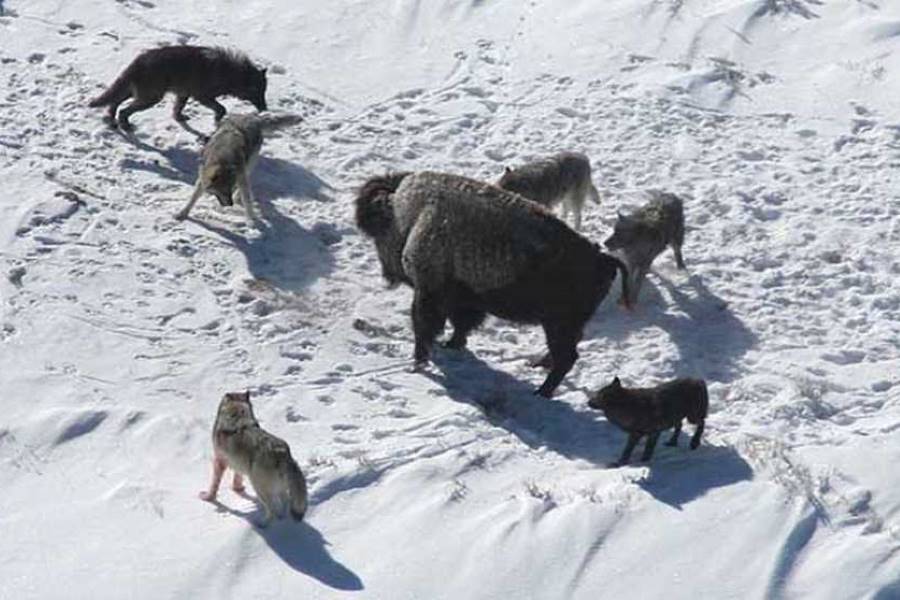
In northern Europe and North America, wolves can grow up to 1.6 metres long, 80 centimetres tall and weigh about 80 kilograms. Wolves in Arabia, on the other hand, reach a length of just 80 centimetres and weigh 20 kilograms. Wolves have a long body and a narrow chest, and their tail can account for a third of their total length. Wolves are known for their pointed muzzles. They have 42 teeth. Wolves walk on their four front toes; the hind toe is atrophied. Unlike cats, they cannot retract their claws. At the start of winter, wolves grow a thicker, longer coat that protects them from the cold. They are excellent hunters. They hunt deer, hares, rabbits, wild boar and mice. Carrion, berries and fruit are also part of their diet. They occasionally kill domestic animals, too. They can scent prey from three kilometres away. They have tremendous stamina. It is estimated that they can run more than 60 kilometres in a day. For short periods, they can reach speeds of around 65 kilometres per hour. That is more than twice as fast as a human and faster than most prey animals. Wolves have exceptionally good hearing. They can hear sounds from as far as 10 kilometres away.
Find out:
5. How big and how heavy are wolves, approximately?
6. What are wolves especially good at?
7. Which animals do wolves hunt?
8. What happens to their fur at the beginning of winter?
4 Wolves live in packs

A pack of timber wolves - Image: pixabay.com

A pair of wolves stays together for life - Image: pixabay.com
Wolves rarely travel alone. They usually live in groups of 5 to 10 animals. Such a group is called a pack, which usually consists of a pair of parents and their young. Wolf parents stay together for life. Young wolves stay with their parents for two to three years, until they eventually leave to start a pack of their own.
A pack lives in a territory that can vary in size. The territory’s boundaries are marked with urine and defended against other wolf packs. Their characteristic howling also helps them claim their territory. Wolves constantly roam their territory, covering long distances. A wolf pack can bring down animals larger than any one wolf. Their prey is usually older, weaker or young animals. The wolves separate them from their herds and then surround them.
They are brought down and killed with a bite to the back of the neck. Pets grazing outdoors without the protection of sturdy fences or strong dogs are easy prey.
Find out:
9. Who belongs to a wolf pack?
10. How do wolves mark their territory?
5 young wolves

Young wolves
Image: pixabay.com
Wolves mate between January and March. After 60 to 70 days, the pups are born in a den. On average, a female wolf gives birth to four to seven pups.
Puppies are born blind and weigh around 300 to 500 grams. Their eyes remain closed for the first two weeks. Young wolves are nursed by their mother until they are eight weeks old.
After four weeks, their teeth are developed enough for them to bite and chew meat. They quickly learn to take part in the hunt. Many young wolves die from illness or hunger, are run over, or are killed by people.
Wolves in the wild usually live no longer than twelve years, but in captivity they can live to be up to 18 years old.
Find out:
11. Where are young wolves born?
12. How long can wolves live?
6 The Wolves Return

Wolves are predators
Image: Hamsterkiste
For several years now, wolves have been living again in Germany and other countries in Western Europe. They first migrated from Eastern Europe into Saxony. At first, they settled on uninhabited military training grounds that were no longer used after German reunification. There they could hunt in peace and raise their young. Wolves are strictly protected. They must not be captured or killed. However, the return of the wolf to Germany has revived old fears for many people. Livestock owners in particular are worried. Wolves have even been photographed in residential areas. They are naturally shy animals and avoid people. Even if their numbers grow, we’ll very rarely see them in the forest.
Wolves are predators that hunt roe deer, red deer, wild boar, hares, and other forest animals. They are not interested in hunting humans. However, if they feel that they or their young are threatened, they can also be dangerous to people. There are only a few reports of wolves attacking humans, but it has happened—very rarely.
Find out:
13. Who is deeply concerned about the return of wolves?
14. When can wolves also be dangerous to people?
7 Could we live with wolves again?

Pets must be protected by sturdy fences or guard dogs
Image: Hamsterkiste
Few people have encountered wolves living in the wild. Surveys show that a majority would welcome wolves returning to our forests. However, some strongly oppose this, especially livestock owners.
If we want these large animals to live here again, we have to learn to live alongside them. In wolf territory, livestock must be kept in barns or behind secure fences at night. Large livestock guardian dogs can also defend flocks of sheep against wolves, for example.
When walking in the forest, we should make our presence known by, for example, making clearly audible noises. You must never put out food for wolves, as this would accustom them to being near people. Dogs must be kept on a leash in the forest. Even so, wolves will always see them as intruders in their territory and try to drive them away.
There’s something else we should remember. We don’t live alone on Earth. Do we have the right to wipe out other living creatures because we think they’re useless or dangerous?
Find out:
15. How can pets be protected from wolves?
16. Should wolves be allowed to live here again?