


The Beelitz Sanatorium

Ruins of the Alpenhaus in Beelitz
Image: Hamsterkiste
1 Beelitz
Beelitz is a town in Potsdam-Mittelmark district in the state of Brandenburg. It lies about 50 kilometres south-west of the German capital, Berlin. The town has around 12,800 residents. A lot of asparagus is grown in Beelitz and the surrounding area. That is why the town calls itself “Spargelstadt” (Asparagus Town) on its welcome signs.
Beelitz has a district whose name speaks for itself: Beelitz-Heilstätten. From 1898 onward, the Berlin State Insurance Institute had a facility built here to treat lung diseases.
Patients from Berlin were treated here above all. In 1871, the capital of the German Empire had a population of 825,000. New factories sprang up, attracting many workers. By 1895, the city already had nearly 1.7 million residents; its population had more than doubled in 24 years. Large tenement blocks were built, especially in the north and east. Many families lived in cramped conditions. Coal was used for heating, and soot and exhaust fumes polluted the air. Under these conditions, a dangerous infectious disease spread: tuberculosis.
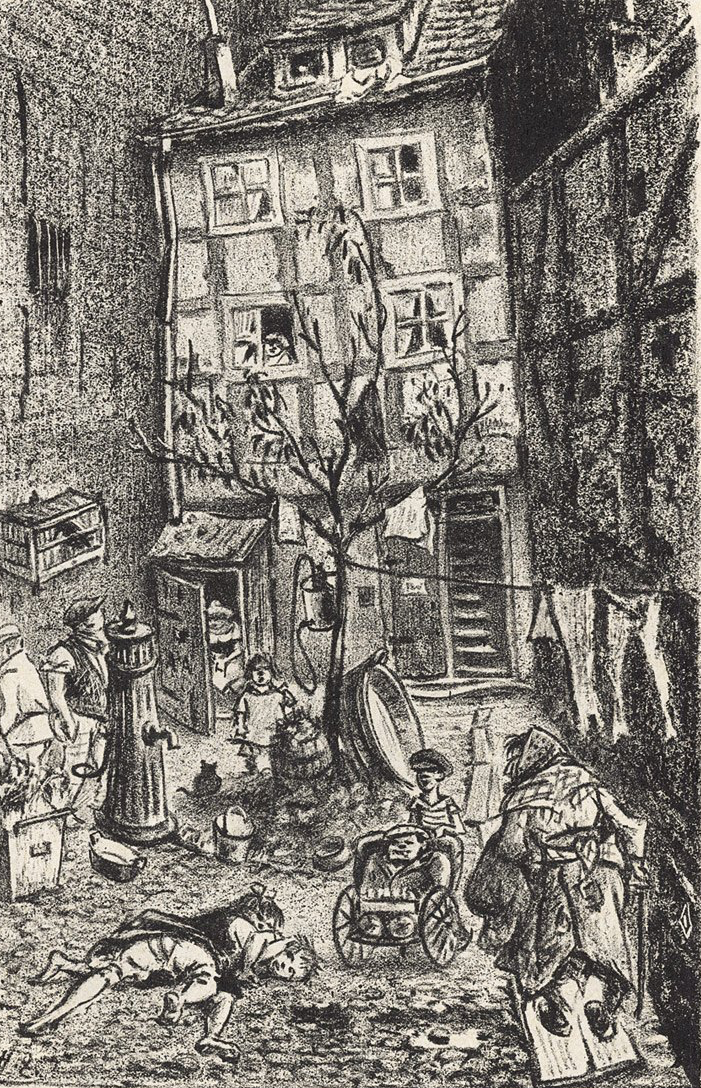
Courtyard in the Scheunenviertel with an outhouse and water pump - Image: Heinrich Zille (1919)
Image: public domain
2 Tuberculosis

Robert Koch discovered the dangerous bacteria that can cause tuberculosis
Image: public domain
Tuberculosis is also known as TB or consumption. Today, only a few people in Europe suffer from it, but it is still one of the world's most serious infectious diseases.
It is caused by tiny bacteria carried by many people. They are passed on to others in droplets released when people breathe. In most people, cells in the body fight the bacteria and keep them in check.
But in about one in ten people, they cause inflammation, usually in the lungs. If the disease is not treated, the tissue dies. Those affected suffer from a mucus-producing cough and shortness of breath. They lose weight and may die.
In March 1882, the doctor Robert Koch discovered the tuberculosis pathogen under a microscope. It took several more years before a vaccine against TB bacteria was invented. But it was only after the development of penicillin that most patients could be cured.
Until 1998, people in Germany were required to be vaccinated against tuberculosis. Teachers, for example, had to have an annual X-ray examination to rule out the disease. The vaccination requirement and annual examinations were then discontinued because the number of cases had fallen sharply.
3 Sanatoriums were built in Beelitz

Men's bathing and shower room in 1904
Image: public domain
Because tuberculosis was spreading rapidly in Berlin, the Berlin State Insurance Institute decided to build facilities for treating patients with lung diseases in a forest near Beelitz. In the end, 60 buildings were built on a site covering 200 hectares. Up to 1,200 patients could receive care based on the latest medical knowledge.
An artificial hilly landscape was created, along with dormitories, kitchen buildings, washhouses and Germany's first district heating plant. A water tower was also built. The heating system's long pipes kept the paths ice-free in winter. Vegetables were grown in large gardens, and a slaughterhouse supplied meat to patients and care staff.
The grounds were divided into wards for infectious and non-infectious diseases, with women and men housed separately in each.
After the First World War broke out on 1 August 1914, the sanatoriums were used as hospitals for wounded soldiers. They were also used as hospitals during the Second World War. At the end of the war, many buildings were badly damaged.
4 The sanatoriums during the GDR era

Ruins of a pavilion in Beelitz
Image: Hamsterkiste
After the war ended on May 8, 1945, soldiers from the Soviet Union occupied the present-day federal states in eastern Germany. The German Democratic Republic (GDR) was established in 1949.
It was organised on the Soviet model. All businesses belonged to the state as so-called “People’s Own Enterprises”. Farming was no longer carried out by individual farmers, but by agricultural production cooperatives. Strong border fortifications were built between West Germany and the GDR, and West Berlin was surrounded by a wall. Only a few GDR residents were allowed to travel to the West.
From 1945 to 1994, the Beelitz sanatorium served as the Soviet Union’s largest military hospital outside its own borders; only one building was accessible to German patients. Since the Soviet soldiers withdrew, many of the sanatorium buildings have stood empty and fallen into disrepair.
5 The Treetop Walk

You can explore the site from a treetop walkway and an observation tower
Image: Hamsterkiste
Various plans were made for the redevelopment of the site. In 2015, a treetop walkway was built on the grounds of the old sanatorium. You can now explore the grounds at a height of 17 to 23 metres. The walkway is almost 800 metres long and 2.20 metres wide. It passes a pavilion belonging to the former women’s pulmonary sanatorium, known as the "Alpenhaus". The building was destroyed by fire in 1945. Today, you can see remnants of the old furnishings and roof structure, as well as many bushes and trees that have since grown on the roof of the ruins.
The treetop walkway also includes a 40.5-metre-high observation tower with a viewing platform. Information boards provide details about the surrounding buildings. There is an excellent view over the extensive grounds of the sanatorium. On a clear day, you can see as far south as the Fläming and as far north as the TV Tower in Berlin. A barefoot park has also been created.