


back to overview
The Old Swede

This glacial erratic lies on the Elbe in Hamburg-Ovelgönne
Image: Hannes Grobe (CC BY-SA 2.5)
It is known as Hamburg’s oldest resident. For many thousands of years, no one knew about it because it lay deep beneath the Elbe. It weighs about 217 tonnes, is between 5.20 and 7.90 m wide, and is 4.50 m high. It is a stone. Stones like this are called erratic boulders. The “Old Swede” is one of the largest erratic boulders in Germany. It was discovered when the Elbe was dredged in September 1999. One of the dredgers suddenly hit an obstacle. Divers established that it was a large boulder. During the first attempt to recover it, the heavy stone slid back into the water.

The first attempt to recover it failed because the stone was too heavy -
Image: Gunnar Ries / CC BY-SA 2.5
It was only on the second attempt that the boulder was recovered. On October 22, 1999, the floating crane "Taklift 4" pulled it out of the Elbe and set it down on the riverbank. Geologists determined that the stone came from the area around the Swedish city of Växjö. That is why it is called the "Old Swede." But how did it get to Hamburg? In the last million years of Earth’s history, there have been four ice ages. Each lasted thousands of years, and they were repeatedly interrupted by long warm periods. During an ice age, temperatures were only a few degrees colder than they are today. But the snow that fell in winter no longer melted in summer. It turned to ice, accumulated in layers, and the layers of ice became glaciers. In some places, the ice eventually became more than 3,000 meters thick.

During the ice ages, Europe looked much like Greenland does today -
Image: Taxiarchos228 / License: Free Art
The ice was pushed farther and farther south by its own weight. As it moved, it carried sand, rubble and huge boulders with it. One of these boulders was the "Old Swede". It reached us during the Elster glaciation, which began 475,000 years ago and lasted about 100,000 years. Eventually, the ice stopped moving. The weather grew warmer, the ice melted and the material it had carried sank to the ground. The "Old Swede" even survived two more glaciations. The last one, the Weichselian glaciation, ended only about 10,000 years ago. Traces of the ice are still clearly visible on the Hamburg erratic boulder. They were made when the stone scraped against other rocks. In some places, the ice has polished the stone smooth. If you ever visit Hamburg, you should go and see the "Old Swede". You’ll find it right on the Elbe, on the beach at Övelgönne in the Othmarschen district. During construction of the Elbe Tunnel in 1998, another large boulder was found. This "Stone of Othmarschen" weighs about 60 tonnes and is 4.90 m long. It now lies in a park above the Elbe Tunnel near Röperhof, a little north of the "Old Swede".
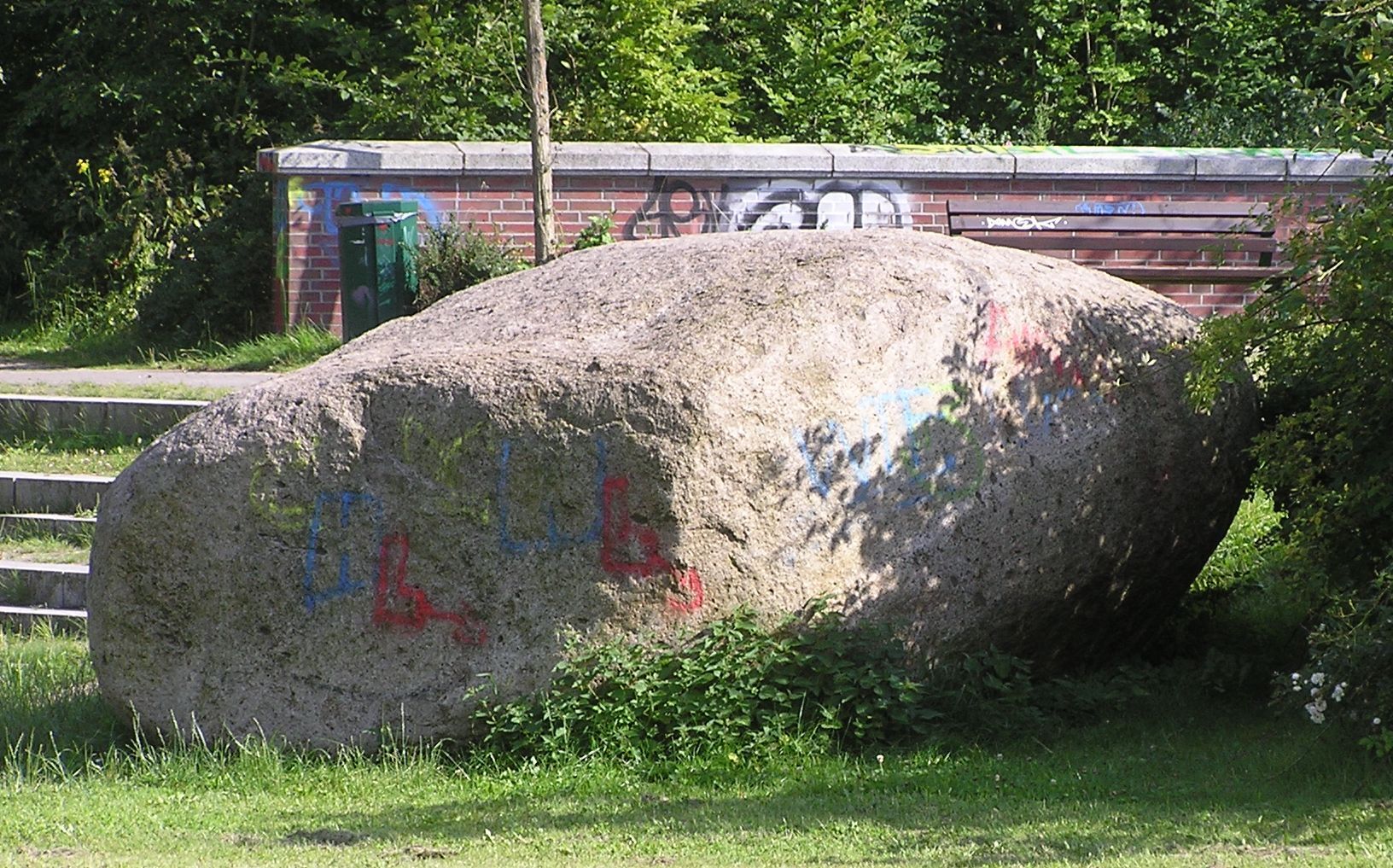
The Othmarschen Stone
Image: Hartmut Müllerchen (CC BY-SA 3.0)