


Gorillas

Gorillas are great apes
Image: Richard Bartz, CC BY-SA 2.5, via Wikimedia Commons
1 The Characteristics of Gorillas
Gorilla mother with her baby
Picture: Ikiwaner, CC BY-SA 3.0, via Wikimedia Commons
Gorillas are great apes and the largest living apes on Earth. They have powerful bodies, well adapted to life in the forest. An adult gorilla has a broad chest, a strong back and very powerful muscles. Their long arms are particularly striking—they are much longer than their legs. Gorillas use them to climb, support themselves and reach for food.
Gorillas usually move around on all fours. They do not walk on their flat palms, but on their knuckles. This way of moving is called knuckle-walking. It protects their hands, which they use to grasp leaves, pick fruit and build nests. Gorillas can also briefly stand upright if they want to.
Gorilla fur is usually dark brown to black and protects them from rain and cold. Their faces, hands, and soles of their feet are almost hairless. Older male gorillas are especially striking. Their backs turn silvery gray. These males are called silverbacks. The silverback is usually the leader of a group.
A gorilla’s head is large and powerful. Gorillas have strong jaws and large molars. These help them chew tough plants such as stems and roots. Their canine teeth are especially large in males. They are not used for hunting, but to intimidate enemies or other gorillas. Despite these impressive teeth, gorillas are peaceful animals.
Gorillas’ eyes face forward. This helps them judge distances well, much like humans. It helps them climb and grasp things. They also have a well-developed sense of hearing and smell. These help them detect danger and find food.
Gorillas also have very dexterous hands with five fingers, including a well-developed thumb. This allows them to grasp small objects precisely. They can tear off leaves, peel fruit and even carry out simple tasks deliberately.
Find out:
- Which animal group do gorillas belong to?
- What is the type of movement called in which gorillas walk on their knuckles?
- What is an adult male gorilla with a silvery-gray back called?
- What do gorillas use to chew tough plants such as stems and roots?
2 Where and how do gorillas live?

Gorillas eat plants
Image: Charles J. Sharp, CC BY-SA 4.0, via Wikimedia Commons
Gorillas live on the African continent. Their habitat is mainly dense forests. Some gorillas live in warm rainforests, while others, such as mountain gorillas, live in cooler mountain forests at higher elevations. There are many plants there for them to eat, as well as enough shelter from predators.
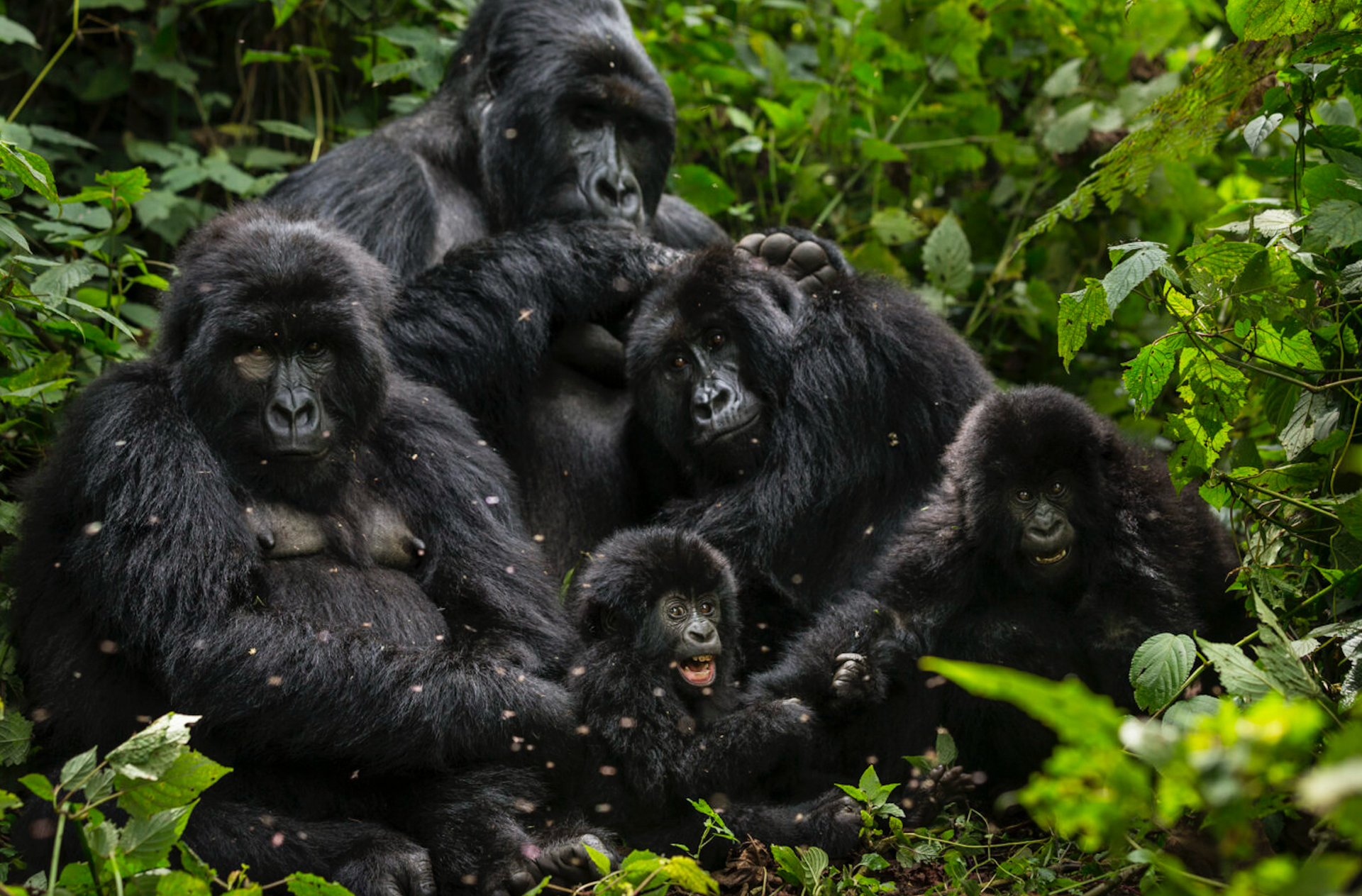
Gorillas do not live alone; they always live in groups, also known as families. A group usually consists of one adult male, several females and their young. The adult male is called a silverback. He leads the group, keeps order, protects the other gorillas and decides where the group goes.
Gorillas are active during the day. They travel through the forest together, eating leaves, twigs, herbs and fruit, and resting in between. Gorillas spend a lot of time eating because they need large amounts of plant food. They eat leaves (for example, from shrubs and trees), stems and shoots, herbs, fruit (depending on the season and region), bark and roots. They usually stay close together.
At night, gorillas sleep in nests they build from leaves and branches. These nests are either on the ground or in low trees. Each gorilla usually builds its own nest; only young gorillas sleep with their mother.
Gorillas are peaceful animals and live together calmly. They communicate through sounds, gestures and looks. Living in a group protects them and helps them thrive in their habitat.
Find out:
5. On which continent do gorillas live?
6. What do gorillas mainly eat?
7. Where Do Gorillas Sleep at Night?
3 Gorillas and Their Young

Silverback gorilla
Image: Thomas Lersch, CC BY-SA 3.0, via Wikimedia Commons
Gorillas take very loving care of their young. A baby gorilla is usually born alone and is very small and helpless at birth. During its first months of life, its mother carries it everywhere. She holds her baby close, keeps it warm, and protects it from danger.
The baby gorilla is nursed by its mother and fed on her milk. Meanwhile, it learns to make sense of its surroundings. It carefully watches how its mother eats, moves and interacts with other gorillas. Step by step, the young gorilla learns how life in the forest works.
At around three to four months old, the young gorilla begins to crawl cautiously and later to walk short distances. Even so, it always stays close to its mother. If danger threatens, it immediately seeks her protection. The silverback, the group’s adult male, also helps protect the young. He watches over the whole group and makes sure the youngsters grow up safely.
As young gorillas grow, they play together a lot. Through play, they practice important skills such as climbing, grasping, and interacting with other young gorillas. Play helps them grow strong and agile.
Young gorillas stay with their mothers for several years. They only become more independent after about three to four years. Through this close care, they learn everything they need to live in a gorilla group themselves later on. Gorillas show us that they are very social and family-oriented animals.
Find out:
8. Who mainly looks after a young gorilla during its first few months of life?
9. What is a young gorilla fed during its first few weeks?
10. Why is play important for young gorillas?
4 Why gorillas need protection

Gorillas live in forests
Image: Caelio, CC BY-SA 3.0, via Wikimedia Commons
Gorillas are among the world’s endangered animals. This means that there are fewer and fewer gorillas, and they are at risk of disappearing altogether. That is why it is so important to protect them.
One of the reasons gorillas are endangered is the loss of their habitat. Large areas of forest are being cleared, especially in Central and West Africa, for example, to make room for fields, roads or settlements. But gorillas live only in these forests. When the forest disappears, they lose their home and can no longer find enough food.
Another reason is poaching. Some people hunt gorillas even though it is illegal. They do it for their meat or to sell young gorillas. Many animals are killed in the process, and gorilla families are torn apart.
Gorillas also reproduce very slowly. A gorilla rarely has offspring, and usually only one baby at a time. Twins are very rare among gorillas. It takes many years for a young gorilla to grow up. If many gorillas die, the population can recover only slowly.
Gorillas are also important animals for the forest. By eating plants and spreading seeds, they help new plants grow. In this way, they help keep the forest healthy.
Gorillas are also our close relatives. They share many characteristics with humans and are very social, peaceful animals. Protecting gorillas means protecting not only one animal species, but nature as a whole.
Find out:
11. What happens to the forests where gorillas live?
12. Why do gorillas need the forest?
13. Why are gorillas important to the forest?
14. What characteristics do gorillas have
5 Gorillas are very intelligent animals

Gorilla face (close-up)
Image: PublicDomainPictures
Researchers have discovered that gorillas can solve problems and have good memories. Some gorillas even use simple tools, such as sticks, to check how deep water is or to reach food more easily.
Gorillas also communicate in many ways. They use not only sounds, but also gestures, facial expressions, and body postures. Scientists have counted more than 20 different sounds made by gorillas, which they use to express, for example, warnings or contentment.
Another special feature is that gorillas can show strong emotions. They comfort one another when a member of their group is sad or stressed. This social behavior is similar to that of humans and is being studied in increasingly detail.
Researchers have also observed that gorillas can adapt to changes in their environment, such as different food sources. Even so, they depend on healthy forests and can only partly compensate for the loss of their habitat.
Find out:
15. What special abilities do gorillas have?
16. How do gorillas communicate with one another?
17. What behaviors do gorillas and humans have in common?