


Germany has voted
1 Germany is a democratic country

Members of the Bundestag meet in this building in Berlin. It is called the Reichstag.
Image: Hamsterkiste
February 23, 2025, was an important day in Germany. A new Bundestag was elected that day.
There was a time when princes and kings ruled Germany. They owned large parts of the country, and most people were considered their subjects, with little say in how they were governed. Fortunately, things are different now. Today, Germany is governed by the Basic Law of the Federal Republic of Germany. It includes this sentence: "All state authority emanates from the people." This means that the people determine who governs them. Such a state is called a democracy. The word comes from Greek: "demos" means "people" and "kratia" means "rule." So, in a democracy, the people rule. The people means all of us. More than 84 million people live in Germany. There are clear rules for how the country is governed. They are set out in the Basic Law. For example, it states that the people express their will through elections and referendums.
Research tasks for this chapter:
- What does the sentence “All state authority derives from the people” mean?
- How do people express their will in a democracy?
- Which law sets out the foundations of the state?
2 Representatives represent the people

In a large country, it is not possible for everyone to vote on every issue all the time. That is why, in a democracy, people elect representatives to make decisions on their behalf. They are elected for a set term, usually four or five years. This starts at the local level, in towns and municipalities. Important decisions there are made by the municipal council or city council. It consists of men and women elected by the citizens of the town or municipality. The councils then elect a mayor. Although mayors lead their towns or municipalities, they must obey the law and answer to the council. They are elected for a fixed term and can be voted out if they do a poor job. Each district also has an assembly of elected representatives called a district council. It elects and oversees the district administrator. In each federal state, elected representatives make up the state parliament, known in Hamburg, Bremen and Berlin as the House of Representatives or Bürgerschaft. Their job is to pass laws for their federal state, for example laws governing education. They also elect and oversee the minister-president. Finally, there are representatives elected to serve all of Germany. They make up the German Bundestag and act on behalf of everyone living in Germany.
Research tasks for this chapter:
4. What is the parliament in your town or city called?
5. What is the name of the parliament in your state?
6. What is the name of the parliament for all of Germany?
3 The German Bundestag

This building houses offices for members of parliament
Image: Hamsterkiste
Members of the German Bundestag debate and decide on laws that apply to the whole country. They are elected for four-year terms. While serving in the Bundestag, they receive a salary, just like anyone else with a job. Members' salaries are called "Diäten". They currently amount to €11,227 per month. They are also provided with an office and funds to employ staff. In addition, they can travel free of charge on Deutsche Bahn at any time. They may add the abbreviation MdB to their name, meaning "Member of the Bundestag". Bundestag members meet in Berlin. Each of them also serves on committees dealing with different areas of policy. For example, the Foreign Affairs Committee discusses relations with other countries. The Finance Committee discusses how much money the state should and may spend. Members of the Bundestag also have another important task: electing the Federal Chancellor.
Research tasks for this chapter:
7. What are the responsibilities of members of the German Bundestag?
8. What is their salary called, and how much is it?
9. What special rights do they have?
4 The political parties
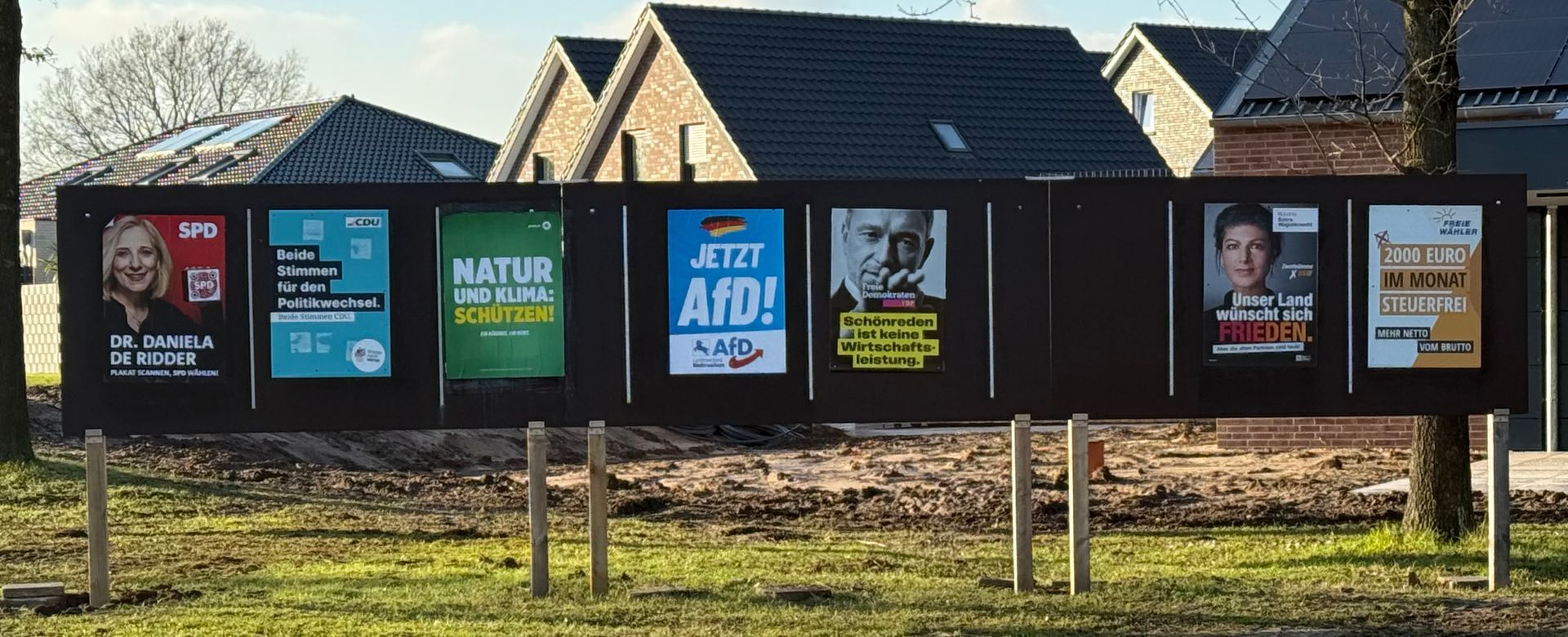
Before the February 2025 election, the parties used posters to campaign for votes
Image: Hamsterkiste
The process for a federal election is somewhat complicated. Germany is divided into constituencies. In each constituency, people can stand for election as members of parliament. This is called running for office. You only need to be over 18 and a German citizen. But simply running is not enough. You need to become known, campaign, explain your goals and intentions, discuss them with other candidates, and have enough time and money to do all of this. Since it is difficult for an individual to manage all this, there are political parties. They bring together people with the same or similar goals. The parties with the most members at present are
- SPD (Social Democratic Party of Germany)
- CDU (Christian Democratic Union)
- Bündnis90/DIE GRÜNEN
- CSU (Christian Social Union)
- FDP (Free Democratic Party)
- THE LEFT
- AfD (Alternative for Germany)
- Sarah Wagenknecht Alliance (BSW)
In a federal election, these parties nominate a candidate in every constituency. The CSU fields candidates only in Bavaria, while the CDU fields candidates only in the other federal states. The parties also draw up state lists, one for each federal state. These lists contain the names of all the candidates hoping to be elected as MPs for that party in that state. The candidates appear in a fixed order on each list.
Research tasks for this chapter:
10. Who supports the candidates?
5 The federal election

Ballot paper for the 2017 federal election in constituency 51

... and a voting booth.
The election is organized and run by the Federal Returning Officer, who also determines the final result. All citizens who are at least 18 years old on election day are eligible to vote. For the election, each constituency in Germany is divided into several smaller polling districts. Each polling district has a polling station, which may be located in a school, kindergarten or town hall, for example. Polling stations are open from 8 a.m. to 6 p.m., and citizens can cast their votes there. Anyone who cannot get to a polling station may vote by mail before election day. Their ballot is kept in an envelope and not opened until election evening. At the polling station, voters receive a ballot paper. In federal elections, each voter has two votes. One vote is for a candidate in the constituency where they live. With the second vote, they choose a political party. Elections are secret. That is why small booths are set up in polling stations for voters to fill out their ballots in private.
Research tasks for this chapter:
11. Who is eligible to vote?
12. What are the opening hours of the polling stations?
13. How can you vote if you are away on election day?
14. How many votes can you cast in the federal election?
6 After the election

After the February 2025 election, Friedrich Merz was elected the new Federal Chancellor
Image: German Bundestag / Thomas Ido / photothek
Once the polling stations have closed, the votes are counted and the results are forwarded to the Federal Returning Officer and published. The official results show how many votes the parties received and which candidates were elected. A party must receive 5 percent of all second votes. Approximately half of the elected representatives are chosen in constituencies, and the other half from the parties’ state lists.
A few days after the election, the newly elected representatives meet for their first sessions. Before that, they have to move into their offices or find and furnish a new home in Berlin. All the representatives from each party first meet for internal discussions. They form a parliamentary group. First, they elect a parliamentary group chair. All the representatives then elect a President of the Bundestag and their deputies at the first session of the new Bundestag. Their job is to chair the Bundestag’s sessions for the next four years.
Members of parliament are also responsible for electing the new Federal Chancellor. The Chancellor needs a majority—that is, one vote more than half of all members of parliament. Before that can happen, parties must join together to command a majority of the votes. This is called a coalition. The members of parliament in the coalition then elect the Chancellor.
Research tasks for this chapter:
15. What percentage of the second votes must a party receive to be represented in the Bundestag?
16. Who belongs to a parliamentary group?
17. What are the roles of the President of the Bundestag and the Vice-Presidents?
18. Who elects the Federal Chancellor?