


Flag of the Kingdom of the Netherlands
Image: public domain
Kingdom of the Netherlands
1 Land and People
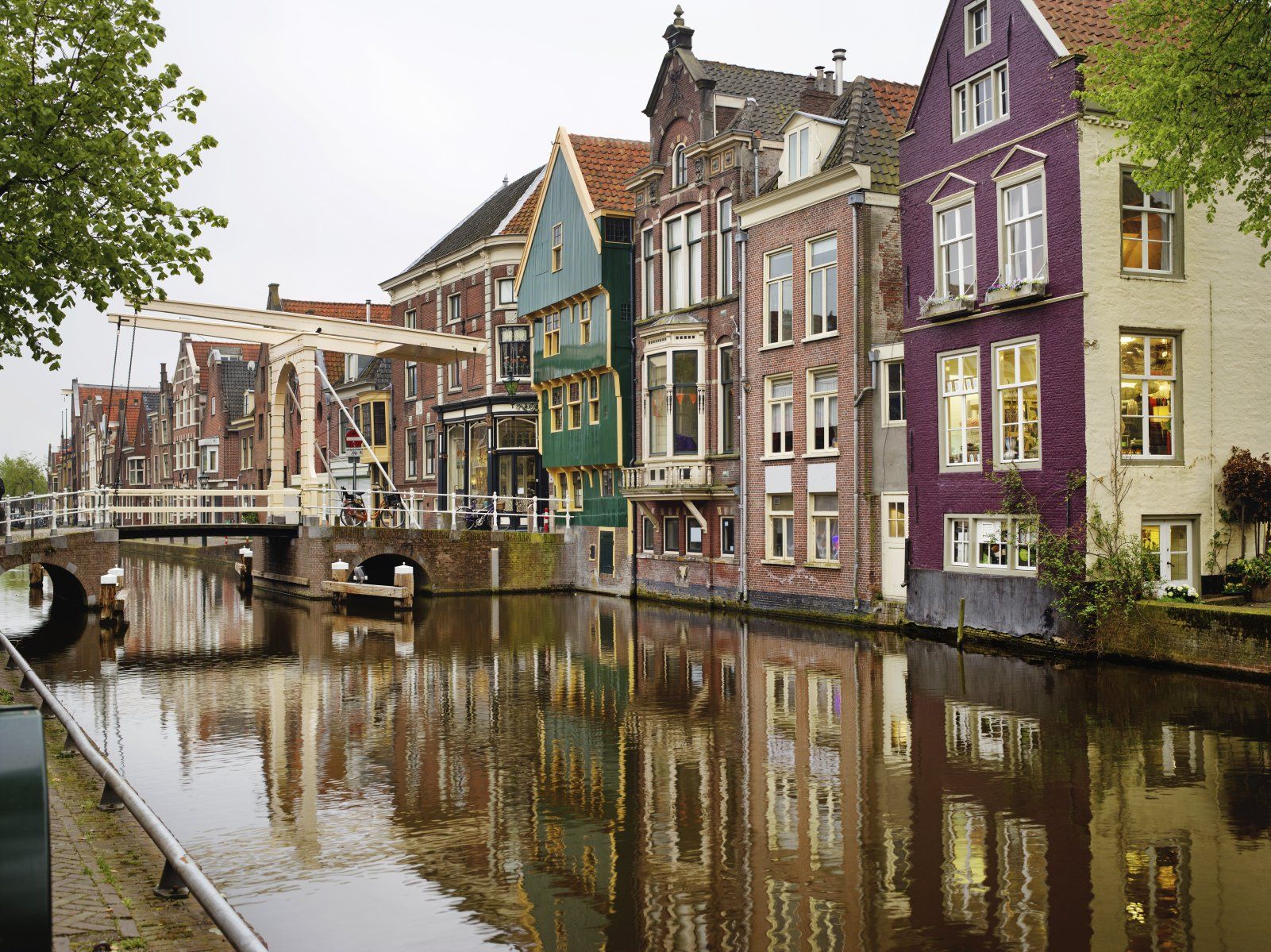
The townhouses in Amsterdam are narrow because they used to be taxed according to their width.
Image: Hamsterkiste
On 1 January 2023, the Netherlands had a total population of 17,815,508. That is slightly less than the German state of North Rhine-Westphalia.
Including rivers, canals, lakes and coastal waters, the country covers a total of 41,543 square kilometers. There are around 413 people per square kilometer on average. The Netherlands is one of the most densely populated countries in the world. Dutch is spoken in the Netherlands. Frisian is also officially recognized and is spoken by around 400,000 people in the province of Friesland. Both languages are related to Low German.
Out of every 100 people in the Netherlands, 5 are foreigners. For another 21, or about one in five residents of the Netherlands, one or both parents were born abroad. Almost half of the people in the Netherlands do not belong to a religion. 24 out of 100 are Catholic, 16 are Protestant and about 5 are Muslim.
2 Cities

Utrecht City Hall
Image: public domain
Amsterdam is the capital of the Netherlands. In January 2023, it had a total population of 921,468. Including its suburbs, the total is even more than 1.2 million people. The Dutch government is based in The Hague, the country’s third-largest city, with 562,416 residents. The second-largest city in the country is Rotterdam, home to 664,071 people. Rotterdam has the largest port in Europe. Other major cities include Utrecht, Eindhoven, Tilburg, Almere, Groningen, Breda, Nijmegen, and Apeldoorn.
3 Provinces

Houses in Willemstad, the capital of Curaçao, a former Dutch colony
Image: Hamsterkiste
The Netherlands consists of 12 provinces: Drenthe, Flevoland, Friesland, Gelderland, Groningen, Limburg, Noord-Brabant, Noord-Holland, Overijssel, Utrecht, Zeeland and Zuid-Holland.
The Netherlands is often also called “Holland.” That is not quite correct, since North Holland and South Holland are only two of its twelve provinces.
There are 388 municipalities in the country in total. The country borders the North Sea to the north and west. Its coastline is 450 kilometres long. The Netherlands includes not only its European mainland territory but also islands in the Caribbean.
The islands of Aruba, Curaçao and Sint Maarten are self-governing countries, but they belong to the Kingdom of the Netherlands. The three Caribbean islands of Bonaire, St. Eustatius and Saba are referred to as “special municipalities” of the Netherlands. In the past, these islands, like Indonesia, were colonies of the Netherlands.
4 Rivers

The Dutch live with, beside and on the water. Large areas of the country are covered by bodies of water, rivers and canals. Much of the country lies below sea level, so it must be especially well protected against flooding.
The three largest rivers are the Rhine, the Meuse and the Scheldt. The Meuse and the Scheldt rise in France, while the Rhine rises in Switzerland. These rivers flow into the North Sea through a vast delta near Rotterdam. The Delta Works are also located there. These enormous structures protect the country from storm surges. The Delta Works are the largest storm surge barrier in the world.
Many places in the Netherlands have canals, which are man-made waterways. They are called grachten. They help carry away the large amounts of water. Of course, they are also great for boating. And some Dutch people love living on houseboats on these canals.
5 Coasts, dikes and landscapes

The Afsluitdijk separates the North Sea (left) from the Zuiderzee
Image: Goevenaar (public domain)
For centuries, the Dutch have worked to protect their country from the waters of the North Sea. A third of the country lies below sea level. Two out of three Dutch people live in these areas. Storms and floods threaten the country.
Without the miles of dikes built over time and the many pumps that drain the land, large parts of the country would have been flooded by the sea long ago. Altogether, the dikes are more than 3,000 kilometres long. But protecting the land from water is becoming increasingly difficult, because sea levels are rising as the climate changes.
The IJsselmeer is the largest lake in the Netherlands. It was once a bay in the North Sea called the Zuiderzee. Then a 32-kilometre-long dyke was built. The bay was cut off from the sea and has been called the IJsselmeer ever since. Large areas within the IJsselmeer were then enclosed by additional dykes. The water was pumped out, creating new land called polders.
The Netherlands is also home to a very special national park: the Wadden Sea. The Dutch section stretches from Marsdiep near Den Helder to the Dollart, where the River Ems flows into the sea. Millions of birds stop here to rest and breed. The Wadden Sea is home to many rare animal and plant species. The Wadden Sea National Park includes 11 inhabited and uninhabited islands. The largest Dutch islands in the North Sea are Texel, Ameland and Terschelling.
The Netherlands are very flat. The highest mountain on the mainland is Vaalserberg, which is just 322 meters high. There are large areas of bogland in the eastern Netherlands, including Bourtanger Moor.
6 Economy

Windmills were once used to drain the land
Image: Hamsterkiste
The Netherlands is a wealthy country. The Netherlands and Germany have close economic ties. Around one in every four products exported by the Dutch is sold to Germany.
The Netherlands mainly produces machinery, vehicles, chemicals, and food. The country is well positioned for global trade. Rotterdam is home to Europe’s largest port. Amsterdam Airport Schiphol is the fourth-largest airport in the world.
Agriculture plays an important role. More than half of the country’s land is used for farming. Crops and food are produced in greenhouses and through horticulture, as well as meat and dairy products such as cheese. The country is also famous for its tulips, which are grown mainly in the west.
The Netherlands has a well-developed network of roads, railways and inland waterways. Many goods are still transported by water. Trains are mainly used to carry passengers.
7 Neighbouring Countries
The Netherlands has only two neighboring countries: Germany and Belgium.
The Second World War placed a great strain on relations with Germany, as the Netherlands was invaded and occupied by Germany. The city of Rotterdam was bombed and badly damaged. Three-quarters of the approximately 140,000 Dutch people who were Jewish were deported and murdered.
Today, the two countries once again have close and friendly relations. The Netherlands and Germany are founding members of the European Union (EU), which now has 27 member states. The euro is the common currency in 19 of these countries.
Among other things, the EU aims to promote trade and travel and to establish common rules for living together in Europe. Above all, it aims to secure peace between peoples and countries so that there will never be another war in Europe.
8 The Netherlands is a kingdom

The City Palace in Amsterdam
Image: Hamsterkiste
The Netherlands has a king, Willem-Alexander. The king is the head of state but has no real power. Parliament votes on laws, and the government makes decisions on important political issues.
People in the Netherlands can freely elect their representatives. In this way, they democratically decide who makes decisions in parliament.
The Dutch celebrate their national holiday on 27 April. It is the birthday of King Willem-Alexander. From 1980 to 2013, Beatrix, Willem-Alexander's mother, was queen and therefore head of state. The king or queen mainly has to make public appearances and, for example, deliver the Speech from the Throne every September.
9 Government and Parliament

The Binnenhof in The Hague is the seat of the Dutch Parliament
Image: pixabay.com
The Dutch parliament is called the States General. It has two chambers: the Senate, with 75 members, and the House of Representatives, with 150 members. Both chambers meet at the Binnenhof in The Hague.
Members of the Senate are elected every four years by the provincial parliaments. The 140 members of the House of Representatives are elected by the people every four years. All Dutch citizens aged 18 and over are eligible to vote.
So far, several parties have always joined forces to govern together. They form a coalition. The Dutch Parliament also includes several small parties that receive only a few votes in elections. The head of government is the prime minister.