


The Old Elbe Tunnel

Today, the Old Elbe Tunnel is mainly used by pedestrians and cyclists
Image: Hamsterkiste
1 - At the beginning of the twentieth century, more and more shipyards and docks sprang up in Hamburg’s harbor, where ships were built and repaired. Wharves were built for loading and unloading. However, these facilities were on the south bank of the Elbe, while the workers lived on the north bank. They therefore had to cross the Elbe twice a day on their way to and from work. For a long time, they did so by ferry.
2 - But as the number of workers continued to grow, it was decided to build a tunnel beneath the Elbe. Construction began on July 22, 1907, on the island of Steinwerder. First, vertical shafts were sunk here and then on the northern bank, with concrete walls. At a depth of 23.5 meters, two horizontal tunnel tubes were then built. Each was made of ring-shaped iron sections called segments. They were joined together and sealed on the inside and outside. The construction site was kept under constant positive pressure to prevent water from breaking in.
3 - However, the workers had to be protected from “decompression sickness.” Before their shift, they adjusted to the increased pressure in special chambers, and after their shift they gradually readjusted to normal air pressure in the chambers.
4 - Two tunnels were built, each 426.5 metres long. It was decided that a horse-drawn carriage with its whip raised should be able to pass through each tunnel. That meant the tunnels had to be 6 metres in diameter. A roadway was laid in each tunnel, and the side walls were elaborately lined. About 3 metres of silt lay above the tunnels, and above that flowed the Elbe, which is about 12 metres deep here.
5 - Large buildings were constructed over the shafts at both ends of the tunnel and covered with copper. The work was completed on July 7, 1911. Construction cost 10.7 million gold marks. In the years that followed, around twenty million people a year used this route to get to the other side of the Elbe.
6 - When the layer of silt was finally only one meter thick, a heavy metal cover was placed over the pipes in the 1980s for extra protection.
7 - The buildings at both ends of the tunnel house four vehicle lifts, each capable of carrying six or ten tonnes. There are also two passenger lifts and stairways.
8 - The Old Elbe Tunnel is now almost 120 years old. Many shipyards have closed, and fewer people work in the port than in the past. As a result, the number of people using the tunnel has fallen sharply. Today, only around 500,000 to 600,000 people cross beneath the Elbe here each year. A much newer and larger Elbe Tunnel was built several kilometres to the west as part of the A7 motorway.
9 - But the historic structure is still one of Hamburg’s most important landmarks. It has been undergoing renovation for some time. One tunnel is already complete and has been restored to its former glory. The work is expected to be finished by 2026.

The building with a dome on the north bank of the Elbe goes 23.5 meters underground
Image: Hamsterkiste

The tunnel walls are decorated with numerous ornamental tiles
Image: Hamsterkiste
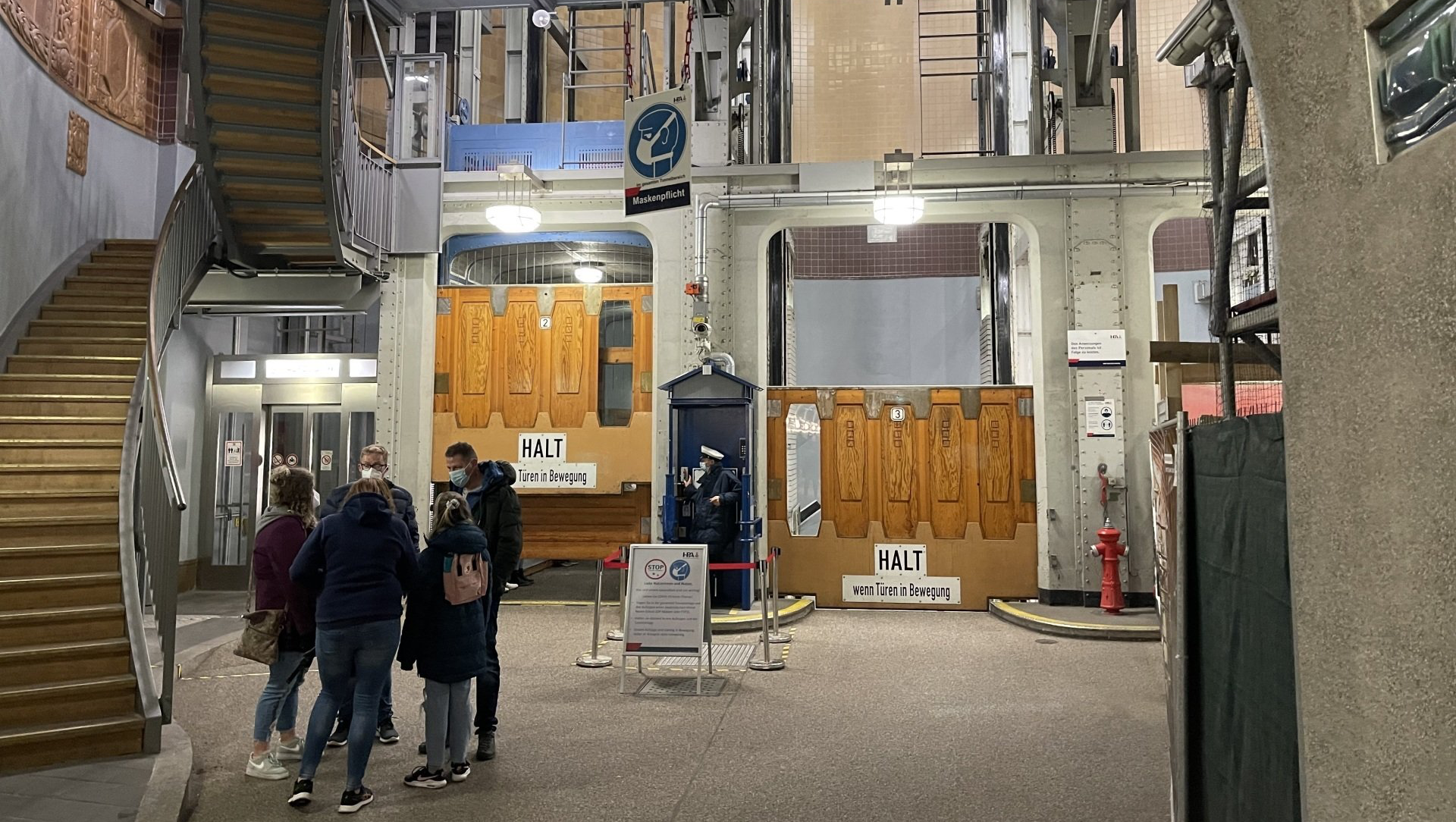
There are four lifts for vehicles and two passenger lifts
Image: Hamsterkiste

The lifts overcome a height of 23.5 metres
Image: Hamsterkiste

A plaque at the entrance provides key information about the Old Elbe Tunnel
Image: Hamsterkiste