


Camels

Tourists ride camels on the island of Lanzarote
Image: Hamsterkiste
1 Camels of the Old and New Worlds

Camels have been used to transport goods for thousands of years.
Image: public domain
When we hear the word camel, we probably first think of animals with humps. But there are also camels without humps. They live in South America and are called guanacos, vicuñas, llamas and alpacas. Since the Americas are sometimes referred to as the New World, we also call them New World camels.
Dromedaries and Bactrian camels, on the other hand, are known as Old World camels. They have humps: dromedaries have one and Bactrian camels have two. People have kept camels as working animals for many thousands of years. Dromedaries and Bactrian camels carry heavy loads or are used as riding animals. Their milk is considered very nutritious and healthy. In South America, llamas and alpacas are also kept as pack animals, but mainly for their wool. People also eat camel meat.
Find out:
1. Which animals are known as “Old World camels”?
2. Which animals are known as “New World camels”?
2 Dromedaries

Dromedaries have only one hump
Image: Hamsterkiste
Dromedaries are found mainly in North Africa and the countries of Arabia. A dromedary can grow up to 3.40 meters long and reach a height of 1.80 meters. Its tail measures only about 50 centimeters.
The animals weigh between 300 and 700 kilograms. Their coats are usually sandy-coloured, but can also be very light or very dark. They have a hump.
The dromedary’s upper lip is split. These animals have long necks, elongated heads and very long eyelashes. They walk at a pace called the camel gait, moving the legs on one side at the same time.
Find out:
3. Where do dromedaries live?
4. How many humps do they have?
5. What is the name for the way dromedaries move?
3 Bactrian camels

Bactrian camels have two humps
Image: Hamsterkiste
Bactrian camels are found mainly in China, Mongolia and Kazakhstan. They grow up to 3 meters long, stand between 1.80 and 2.30 meters tall and weigh up to 500 kilograms. They have two humps. Winters in their native habitat can be very cold, so in fall they grow a long, thick coat, which they shed again in summer. Bactrian camels often look rather ragged because long tufts of fur hang down from their bodies. They, too, move with a pacing gait.
Like all camels, Bactrian camels can cope well with a wide range of temperatures. They can withstand extreme heat as well as bitter cold.
Find out:
6. In which countries and regions are Bactrian camels found?
7. Why does their fur often look unkempt?
4 The special abilities of camels

All camels have calloused feet
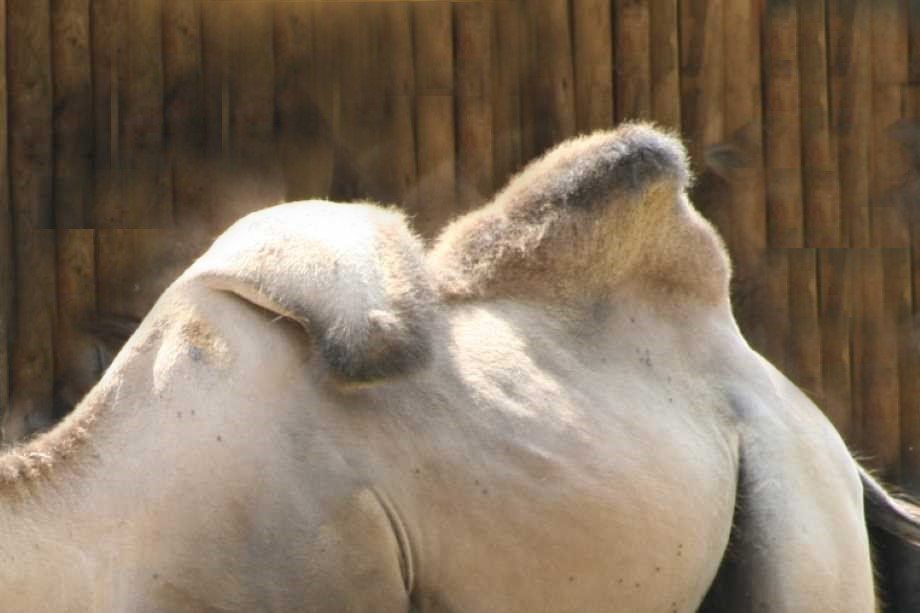
Fat is stored in the humps
All camels belong to the group known as tylopods. They do not have hooves that enclose and protect the entire foot. Instead, their two toes rest on an elastic pad. Dromedaries and Bactrian camels can go for up to 30 days without water. However, when they have access to watering places or wells, they drink 100 to 150 litres in a very short time. They conserve water very carefully, retaining it in their bodies for a long time and producing very little urine. Fat is stored in their humps, which the animals can draw on in times of need. At night, their body temperature drops, and during the day it rises only slowly. This means they use little energy and do not sweat much. Bactrian camels and dromedaries eat plants and are not very fussy about what they eat. Both can close their nostrils, and their eyes are protected by long eyelashes. This keeps sand out and helps them withstand even severe sandstorms.
Find out:
8. Why can dromedaries and Bactrian camels go for a long time without water?
9. How are camels protected from sand getting into their noses and eyes?
5 llamas

Llamas are sometimes kept as pets in Europe too
Image: Hamsterkiste
Llamas are often kept as domestic animals in South America. They are used to carry loads, their wool is put to use and their meat is eaten. Llamas grow to 1.5 to 2 metres long, reach a shoulder height of 80 to 120 centimetres and weigh around 120 to 150 kilograms. Their coats consist of very fine, dense wool, which offers little protection from rain. Llamas also have a split, highly mobile upper lip. Like all other New World camelids, they feed mainly on grasses, lichens, leaves and shrub shoots. Males readily spit with surprising accuracy when defending their herd.
Find out:
10. Where do llamas live?
11. What do llamas eat?
12. How do llamas defend themselves?
6 Alpacas

Alpaca wool is highly prized
Image: Hamsterkiste
Alpacas are often kept as pets, too, mainly for their wool. They are smaller than llamas and weigh only about 60 kilograms. The coats of some alpacas are almost black, while others are light brown to almost white. Alpacas are shorn once a year, yielding an average of 6 kilograms of wool. It is estimated that there are about 4 million alpacas worldwide, 3.5 million of them in Peru alone.
Alpacas are also kept by farmers and hobby breeders in Europe.
Find out:
13. Why are alpacas kept as pets?
14. Which country is home to particularly many alpacas?
7 Guanacos and vicuñas

Guanacos are wild camels and the ancestors of llamas

Wild vicuñas at Lake Chungará in Chile
Guanacos and vicuñas are wild camelids. Guanacos are found mainly in Peru, Ecuador, Bolivia, Chile, and Argentina. They live in family groups of around 15 animals, led by a male.
Vicuñas prefer high-altitude habitats in the Andes of South America, mainly at elevations between 3,500 and 5,500 meters. They are the smallest species of New World camelid. Vicuñas have lower incisors that grow continuously, like those of rodents.
They have the finest fleece of all camelids. It is very thin and acts as an insulating layer against the cold. Vicuñas also live in family groups.
Find out:
15. Which countries are home to guanacos and vicuñas?
16. What is one way in which vicuñas resemble rodents?