


In the little crocus wood - Video: Hamsterkiste
The blooming messengers of spring
In January, February and March, the days start getting longer again. But it is still cold, and sometimes there is still snow on the ground. Even so, new life is already stirring in nature. The first spring flowers bloom despite frost and snow. We call them early bloomers.
At this time of year, the trees let in plenty of light because they have not yet grown leaves. Some plants make use of this light, as they have to live in the shade of the trees in summer. They begin to flower and grow. The soil is still too cold for them to absorb nutrients. But many early bloomers formed root tubers or bulbs the previous year, where they stored nutrients. They live off these now. They usually have no trouble with the cold; some are even specially protected against it.
Squill

There are up to ninety different species of squill, including Siberian squill. It is closely related to the two-leaf squill. They are called squills because their flowers often glow a beautiful blue, almost like the sky on a sunny day. Squills grow from bulbs. Their stems grow to about 10 to 15 cm long, with up to 3 flowers on each stem. Squills bloom from March to April. They spread by seed or by bulbs that grow from the mother bulb. These bulbs can also be planted in autumn. The seeds are often spread by ants. Squills grow in forests, as well as in parks and gardens. They like shady or partly shady spots. When they spread into the wild, they can grow in great numbers.
Wood anemone

The wood anemone is one of the first plants we can enjoy in spring. It blooms from March to April/May. The plants grow to about 10 to 25 cm tall. Three so-called bracts grow on each stem, but only one flower. The flower itself consists of 6 to 8 petals.
Wood anemones grow from a rhizome about 30 centimetres long. This is an underground, branching rootstock that also stores nutrients. New plants can grow from different parts of the rhizome. Flowering wood anemones can be found in our forests in early spring. They need plenty of light, so they only flower while the trees are still bare. They often grow in large numbers. All parts of the plant are poisonous, so you should never eat any of them.
Christmas rose

The Christmas rose is also known as black hellebore, Christmas flower or snow rose. Its flowers are white to reddish and consist of 5 petals. The Christmas rose grows to 15 to 30 cm tall. Its scientific name is "Helleborus niger".
The Christmas rose got its name because it can produce its first flowers as early as Christmas. The plant is found mainly in southern Europe and the Alps. In the past, it was grown in gardens as a medicinal plant. Substances extracted from it were used to treat kidney inflammation, urinary poisoning and dropsy.
Some of the compounds in the Christmas rose are poisonous. They can cause nausea, diarrhoea, shortness of breath and irregular heartbeat. Ancient accounts tell how, in 600 BC, the Greek city of Kirrha was under siege. The besiegers diverted a river that flowed through the city. The inhabitants suffered from extreme thirst. After a few days, the besiegers let the river water flow back into the city. However, they had poisoned it with Christmas rose roots. The inhabitants drank the water and were then afflicted by severe diarrhoea, forcing them to surrender the city.
Forsythia

The forsythia blooms as early as March, before its green leaves appear. It was named after the English gardener William Forsyth. Its botanical name is "Forsythia".Forsythias grow to between one and three metres tall. They belong to the olive family and are related to the olive tree. Olive trees, however, are found mainly in countries around the Mediterranean. The olive family includes more than 900 species. Forsythia originally grew mainly in Asia and south-eastern Europe. Here, it was first planted as an ornamental shrub in gardens and parks.Related plants include lilac, privet and jasmine, as well as African blackwood, which grows in southern Africa. Insects are not attracted to forsythia, so you will rarely see them on its flowers. Forsythia flowers produce no nectar, only pollen.
Common hazel

The common hazel grows as a shrub. It can grow up to 7 m tall. In the past, hazel was thought to ward off witches and evil spirits. It is sometimes still called witch hazel today. Male and female flowers grow on the same shrub. The male flowers form hanging catkins. The hazel blooms from February to April. The reddish female flowers develop into tasty hazelnuts, which are enjoyed by people and animals alike. Many different insect species also feed on the leaves, fruit or sap of the common hazel.
Unfortunately, hazel pollen triggers allergies in some people. Its botanical name is “Corylus avelana”.
Coltsfoot

Coltsfoot is also known by many other names, such as horse’s-foot, field coltsfoot, foal’s foot, horsehoof and bricklayer’s flower.
This plant is found on embankments, scree slopes, and along the edges of paths and fields. From February to April, it sends up its yellow flowers. The leaves grow only afterward. These leaves grow to about the size of a hand and resemble the shape of a hoof or a heart. The plant as a whole grows to about 10 to 30 centimetres tall.
Coltsfoot reproduces by seeds and underground runners called rhizomes. The plant is very hardy, can spread quickly and is often one of the first plants to grow on damaged soil. Its flowers, leaves and roots have long been used as remedies. They are sometimes used to make tea for coughs or asthma. Its botanical name is “Tussilago farfara”.
Polyanthus primrose

In Latin, the word "prima" means first. Primroses are flowers that bloom very early in the year. There are about 500 species of primrose.
The cushion primrose is especially common here and is easy to grow and propagate. This plant is sometimes also called the "stemless cowslip" or simply "primrose". There are around 400 different species, with flowers in many colours. It is a very popular spring flower.Cushion primroses grow from seed. They reach about 10 cm in height. The plant forms a rootstock, also known as a clump. Most cushion primroses are now grown in pots in greenhouses and planted out in gardens in March. They flower from February to April. The botanical name is "Primula vulgaris".
Crocuses

Crocuses come in many colours, such as purple, white and yellow—but not a true red. They flower from the end of February until May. There are about 235 species of crocus, found across Western Asia, Europe and North Africa, and as far east as China.
Crocuses are small, rarely growing taller than 12 cm. Their leaves are lance-shaped. If you want crocuses to grow in the same spot the following year, don’t cut off the leaves after flowering. That’s why crocuses are better suited to growing under trees or in flower beds than on a lawn. Crocuses originate from the Mediterranean region. A crocus grows from a corm.
The precious spice saffron is obtained from the crocus species “Crocus sativus.” In the past, saffron was used to dye textiles and cakes. An old nursery rhyme says: ... saffron makes the cake yellow.”
Liverwort

The liverleaf grows to about 10 to 25 cm tall. The plants stay green even in winter. They form a broad rhizome in the soil. This is an underground stem with many shoots, branches and offshoots that can reach up to 30 cm into the ground.
Liverworts bloom from March to April, making them among the earliest plants to flower in spring. The flowers close in rainy weather and in the evening. Repeated opening causes the flower-covering leaves to grow, so that during the flowering season they reach about twice their original size.
The flowers produce no nectar, but they produce plenty of pollen, attracting bees, beetles and hoverflies. The flowers last for about eight days.
Spring snowflake

This plant is also known as the spring snowflake. It is sometimes mistaken for the snowdrop. The spring snowflake also produces white flowers with a very strong fragrance. The plants bloom from February to April. They grow from bulbs, which provide them with nutrients. Spring snowflakes grow to about 10 to 30 cm tall. They grow in forests, in thickets, in meadows, and in gardens. They are slightly poisonous. If you find them in the forest, you must not pick them, as they are protected. Their botanical name is “Leucojum vernum”.
Daffodil
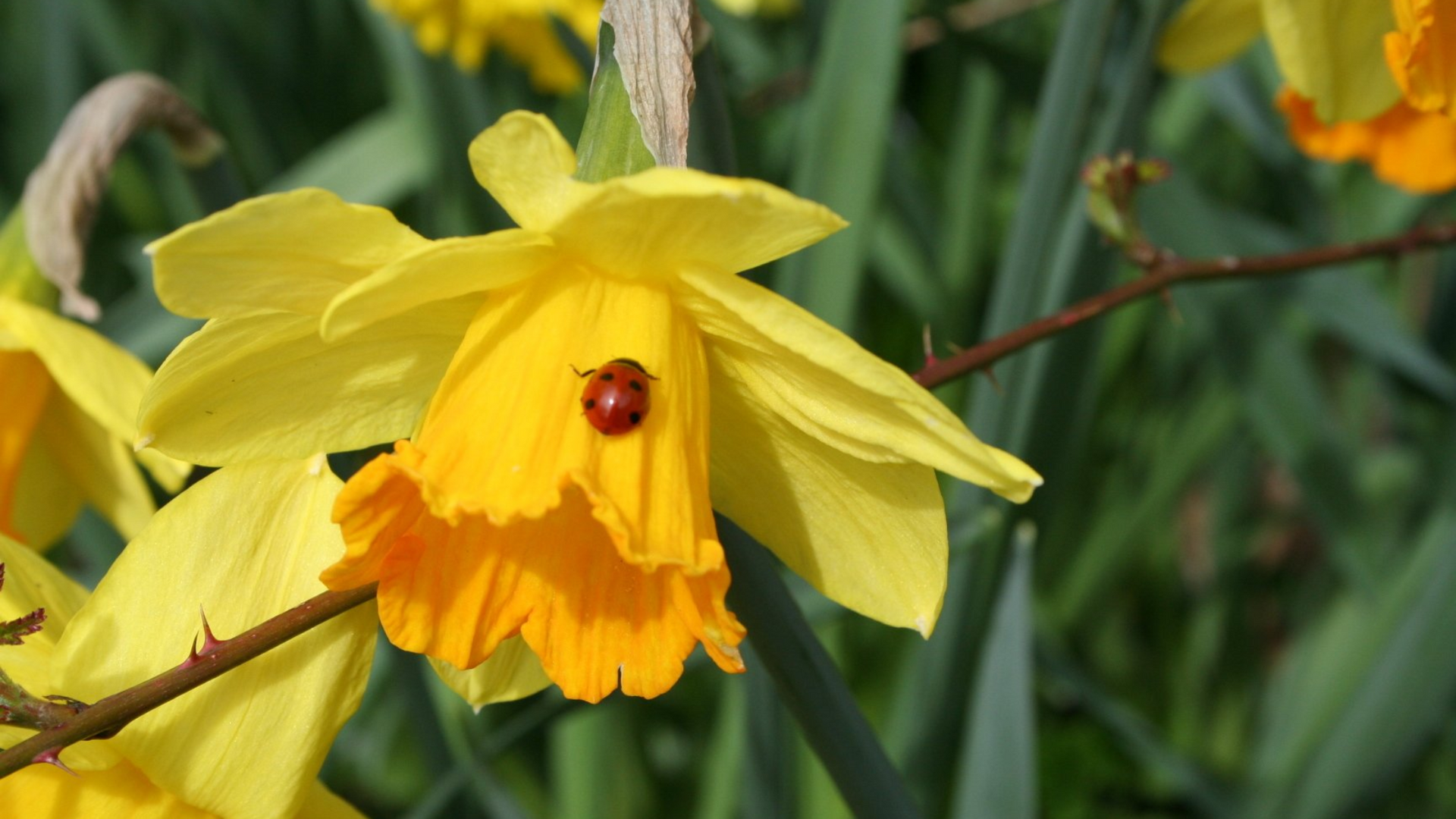
There are almost 8,000 different species of this plant. Daffodils go by many names. The yellow daffodil is especially common here. Because it usually blooms at Easter, it is also called the Easter bell. Daffodils grow up to 45 cm tall. The flowers are usually yellow, but some daffodils have white or pink flowers. Daffodils originally come from countries around the Mediterranean. According to legend, the Greek youth Narcissus, who was deeply in love with himself, was turned into this flower by the gods. Daffodils like loose soil. They reproduce by producing offsets. They need plenty of water while flowering. The botanical name of the yellow daffodil is “Narcissus pseudonarcissus”.
Grape hyacinth

This plant is also called the lesser grape hyacinth. It grows from an egg-shaped bulb. The bulb usually produces two leaves and a stem that grows up to 20 cm tall. An inflorescence forms at the tip of the stem, with individual flowers clustered closely together. The flowers are blue and about 3 to 4 millimeters long. The bulbs sprout for several years in a row. Grape hyacinths bloom from March to April. The plant contains toxic substances. Hyacinths originally come from countries around the Mediterranean, such as Syria and Lebanon. In the past, hyacinth bulbs were almost as valuable as tulip bulbs.
14 Primrose

The cowslip is sometimes also called the “key of heaven.” According to legend, one day the Apostle Peter, who guards the gates of heaven, lost his keys. They fell to Earth and became a flower. Unfortunately, cowslips are becoming increasingly rare. They grow in meadows, among bushes and in coniferous forests. They are found in Europe and western Asia. The flowers are golden yellow and grow on long stems. At the end of each stem, an umbel of many flowers forms. Cowslips bloom from late March to May. They grow to a height of 30 cm. Medicines can be made from the plant. Its botanical name is “Primula veris.”
15 Snowdrop

Snowdrops are among the first flowers to bloom each year. In February and March, we find them in gardens, along paths or in the woods. They can even bloom beneath the snow. They grow from bulbs, but also from seeds. Each plant produces 2 long leaves. The white flowers have 3 outer and 3 inner petals.
Snowdrops grow to about 10 to 25 cm tall. Daughter bulbs grow from the bulbs, and new plants can grow from them. Snowdrops are poisonous! Eating parts of the plant can cause vomiting, sweating or diarrhea. Snowdrops must not be picked because they are protected by law. Their botanical name is "Galanthus nivalis".
16 Glory-of-the-snow

This flower is also known as snow glory, glory-of-the-snow, and star hyacinth. It blooms from March to early April. The plants spread by seed and by offsets. They can cover large areas and thrive in a spot that gets some sunlight, known as partial shade.
Glory-of-the-snow has star-shaped flowers in shades of blue, pink or white, often with a white centre. Its leaves are narrow. The plant needs little care and spreads quickly.
The seeds are often dispersed by ants. If you want snow glory in your garden, wait to mow the lawn until the plants’ leaves have died back, and don’t let fallen leaves build up too thickly in autumn.
17 Violets

Violets include around 500 different species, many of which grow wild, while others have been cultivated as ornamental plants. The popular pansies belong to this family too. Violets bloom in spring, though some species also flower in summer or autumn.
Violets often have heart-shaped leaves and delicate, fragrant flowers. Depending on the species, the flowers may be violet, blue, yellow, white, or multicolored. The flowers of wild violets have a special feature: 3 petals point downward, while 2 stand upright.
Violets spread through seeds and underground runners. They grow along roadsides and in parks, woods and gardens. They grow to about 20 cm tall. Because violets are so beautiful, many poems have been written about them.
18 Willow

There are 30 to 40 species of willow in Europe. They grow as trees and shrubs. The most common species include the goat willow, also known as the palm willow, and the weeping willow. The branches of the basket willow are suitable for basket weaving. Willows grow in damp soil. Their flowers are also known as “pussy willows”. Male and female flowers grow on separate shrubs. Willows bloom from March to April. Their flowers contain plenty of nectar, which bees, bumblebees and butterflies like to feed on. As they do so, these insects brush against the pollen. They carry it from flower to flower, helping willows reproduce. In some Catholic churches, willow branches are blessed and processions are held on Palm Sunday, the Sunday before Easter. This commemorates Jesus’ entry into Jerusalem.
19 Witch hazel

Witch hazel is also called Hamamelis. Here, it is mostly used as an ornamental plant in gardens and parks. The shrubs grow slowly, should be planted on their own, and pruned as rarely as possible.
They bloom between December and February, making them one of the few species to flower during these winter months. The flowers appear before the leaves and have a very pleasant scent.
The plants produce capsules, each containing just two black, shiny, flat seeds. When the seeds are ripe, the capsules burst open explosively, flinging the seeds about 10 meters away.