


The sparrowhawk is dark brown on top. Its underside is whitish with brown bars. A sparrowhawk can easily be mistaken for a goshawk, but it is much smaller. Males are about 28 cm long, while females are 38 cm long. Sparrowhawks live in forests with plenty of undergrowth and clearings. They hunt birds. The smaller male catches prey up to the size of a blackbird, while the larger, stronger female also takes on wood pigeons. In April, sparrowhawks build their nest, called an eyrie, usually in the crown of a conifer. Sparrowhawks often breed in the same territory year after year. They sometimes reuse the old nest from the previous year. The female usually lays 5 eggs in the nest. She incubates them for about 34 days. During incubation and the first few weeks after the chicks hatch, the male provides food for the female. At first, the father also brings food for the chicks. Sparrowhawks that live in northern Europe spend the winter further south. In central Europe, they usually remain in their territory all year round. - Image: public domain
52 Starlings

The starling has splendid gray-black plumage that shimmers green and purple. It may have white spots. Over the course of summer, the iridescent coloring fades and the plumage turns black. Starlings grow to about 22 cm long and weigh 80 g. Starlings feed on insects, snails, worms, and berries. They usually look for food on the ground. They are very sociable and often live together in large flocks. They can be found in gardens and parks in large cities, as well as in forests far from people. The song and droppings of large gatherings of starlings can become quite a nuisance. Starlings nest in cavities. They readily use nest boxes provided by people. In April or May, the female lays 4 to 6 eggs. Both parents take turns incubating them, but only the female does so at night. The young hatch after 11 to 12 days. They are cared for in the nest for 3 weeks. Some starlings are resident birds, while others migrate. Birds from northern regions migrate as far as North Africa in winter, where they sometimes gather in their millions. - Image: Hamsterkiste
53 European goldfinch

The European goldfinch is also called the thistle finch. Its head is black, white and red, and its wings have yellow markings. It grows to about 12 cm long. Goldfinches live in woods, orchards and parks, often near areas with wild herbs. There they find their favourite food: the seeds of thistles and dandelions. They are no longer often seen in our area. They like to gather in flocks, except during the breeding season. The goldfinch’s nest is a true work of art and takes several days to complete. It is built a few metres above the ground in a tree’s branches. The female usually lays 5 eggs in it. The male feeds the female while she incubates them. After 12 to 13 days, the chicks hatch; they leave the nest two weeks later. At first, the chicks are fed mostly insects, then gradually get used to half-ripe seeds. Goldfinches can also be seen here in winter. - Image: Armin Maerz (CC BY-SA 2.5)
54 Mallards

Mallards grow to about 55 to 60 cm in length and have a wingspan of up to 95 cm. Males and females can usually be distinguished by their different plumage. Male ducks are called drakes. They have grey-brown feathers, and their heads shimmer green. On their tails, they have the so-called “drake curls.” Their bills are greenish-yellow. Females are mottled brown and grey, with dark grey to brown bills. In July and August, however, the males’ plumage is hardly distinguishable from that of the females. The colour of their bills is the only way to tell them apart, as it does not change. The shedding and replacement of feathers is called “moulting.” Mallards have 10,000 down feathers and other feathers. These protect them well against wet and cold. They regularly coat their feathers with oil, taking it from the preen gland on their rump with their bills. Mallards are found almost everywhere there are ponds, lakes and rivers. They feed on green plants, their seeds and fruits. They also eat molluscs, crayfish, tadpoles, small fish, worms, snails and frogs. They love to “dabble,” dipping their heads underwater and searching for food on the bottom of shallow water. Mallards are hunted by foxes, raccoons and birds of prey, while rats and martens often raid their nests. Their nests are simple, shallow hollows in the ground. Females begin laying eggs in March. A clutch usually contains about 7 to 16 eggs. The incubation period is 25 to 28 days. The ducklings leave the nest after just a few hours and can swim straight away. In their natural habitats, mallards can live for about 10 to 15 years. The ducks that live here stay here through the winter, too. Mallards from northern and eastern Europe are migratory birds that spend the winter in places where they can find open water. - Image: Hamsterkiste
55 Black Swans

The black swan is also sometimes called the black swan. These birds originally come from Australia. They were brought to Europe as ornamental birds, and there are now also wild populations here. The black swan's plumage is almost entirely black. Its eyes and bill are red, with a white band at the tip of the bill. The birds grow to 110 to 120 cm long, with a wingspan of about 160 to 180 cm. They have very long necks.
Black swans prefer shallow waters with little current. They like to live together in large groups. Once a female and male swan find each other, they stay together for life. Black swans usually breed in colonies, sometimes as early as winter. They build a large nest in the middle of a body of water and use the same nest again each year. The female lays four to eight eggs, which both parents incubate for five or six weeks. The young birds are fully grown at about five months old.
Black swans feed on aquatic plants, algae and grain that they find in fields near bodies of water. - Image: Hamsterkiste
56 Eurasian Collared Doves

The Eurasian collared dove is easy to recognize by the black band on the back of its neck. It has a dark bill and red legs. Its plumage has a slight reddish-brown tinge. It grows to about 30 cm long and weighs 150 to 200 g. In the past, Eurasian collared doves were found mainly in southeastern Europe and as far east as India. They have since spread across western and northern Europe. These birds can live almost anywhere, from densely populated cities to parks and open woodlands.
They feed on seeds and also like to eat human waste. Eurasian collared doves breed several times between March and October. Each time, the female lays just two eggs in a simple nest. The chicks hatch after 14 to 16 days and are fed in the nest for about three weeks. They can have young in their first year of life. Eurasian collared doves are resident birds, staying here all year round. - Image: Hamsterkiste
57 Kestrels

The backs of kestrels are rusty red with black spots. The male’s head and tail are gray, while the female’s are brownish. These birds reach about 34 cm in length and weigh 200 to 300 g. Kestrels are still fairly common here. They prefer landscapes with lots of meadows and avoid large forests. They catch their prey exclusively on the ground. They often hover in a “wind-hover” until they spot prey. They feed mainly on mice, but also hunt insects, lizards, frogs, small birds, weasels, and hamsters. Females lay three to six reddish-brown eggs in late April or May in abandoned crow or magpie nests. However, they prefer to nest in holes in the walls of tall buildings. The female incubates the eggs for 28 to 30 days, during which time the male feeds her. The young leave the nest after 30 days, but their parents continue to feed them for another four weeks. Kestrels stay here all year round, so they are resident birds. - Image: pixabay.com
58 long-eared owls
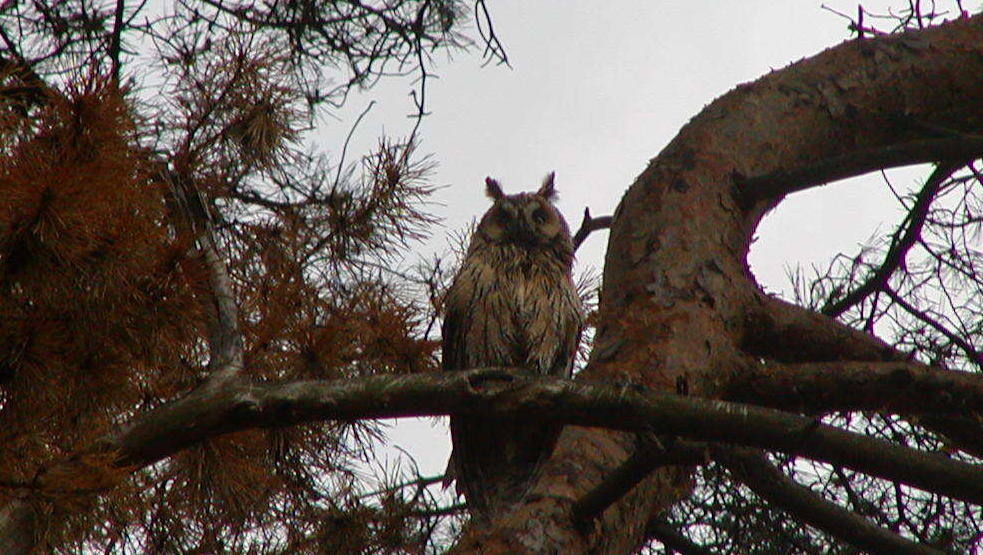
The long-eared owl is 33 to 40 cm long. It is recognisable by the prominent tufts of feathers on its head. When flying, it lays its ear tufts flat. Its plumage is light brown with darker markings. This camouflages it very well in trees and bushes. Long-eared owls live in deciduous and coniferous forests, as well as in parks and large gardens. They are mostly active at night. They mainly catch voles, but also rats, mice, moles, bats, squirrels, rabbits, as well as birds and insects.
Outside the breeding season, long-eared owls often roost together in a tree. They nest from March to May. They do not build their own nests, but take over nests made by crows, magpies and pigeons. They usually raise one brood a year. If they find plenty of mice to eat, they sometimes raise two broods. A clutch consists of 3 to 10 eggs.
The female incubates the eggs for 26-28 days and continues to be fed by the male after the chicks hatch. The young birds stay in the nest for three to four weeks. Long-eared owls live here all year round. - Image: public domain
59 White Storks

The white stork is sometimes also called the adebar or the clattering stork. Its scientific name is Ciconia ciconia. It is one of the largest birds that live here.
White storks grow to about 1 m long and 80 cm tall and weigh around 2.5 to 4.5 kg. Their wingspan can reach 2 m. Their beaks are 14 to 19 cm long. Their plumage is white, with black feathers only on their backs and wings. Their beaks and legs are red. White storks are found in Europe from Portugal to Russia. They live in areas with plenty of damp meadows and pastures that are rarely mown. They need ponds, pools and marshes, where they find plenty of frogs, their main food. They also eat lizards, snakes, large insects and earthworms. Storks prefer to build their nests on rooftops, but they also nest in trees and on cliffs. Their nests are made from twigs and branches. They can reach 2 m in diameter, 4 m in height and weigh over 1,000 kg. Stork pairs return to their old nests again and again. Pairs often stay together for many years. From early April to late August, storks raise their young. The 3 to 7 eggs in a nest hatch after about 33 days. The chicks stay in the nest for about 2 months and are cared for by their parents. If there is not enough food, the parents may throw a chick out of the nest and let it starve. Storks spend the winter in Africa. On their migration, they avoid the Mediterranean because there are too few updrafts there. Western storks fly over France, Spain and Gibraltar to West Africa, while eastern storks fly via Turkey, Lebanon and Egypt to South Africa. The storks return in April or May. In recent years, some storks have also spent the winter here. - Image: Hamsterkiste
60 wren

The wren grows to just 9 cm long, making it the smallest native bird. It is very agile and lively. Its upper feathers are reddish, while its underside is brownish. Its beak is fairly long, and its tail is usually held upright.Wrens live in deciduous and coniferous forests with dense undergrowth, as well as in gardens and parks. They like bushes, woodpiles, ivy and ferns. This bird mainly searches for food on the ground. It eats small insects, spiders, millipedes and worms.It builds a spherical nest from moss, leaves and small twigs. It prefers dark spots. The females lay 5 to 7 eggs, which they incubate alone. The young hatch after 14 to 16 days. They leave the nest after 2 to 3 weeks. Wrens stay here during the winter, too. - Image: Hamsterkiste