


How a deep-well pump works
Video: Hamsterkiste
Oil from Osterwald
1 A treasure in the depths

Crude oil can range in colour from colourless or pale yellow to red, green, dark brown or black
Image: Glasbruch2007 / CC BY-SA 3.0
Osterwald is a small municipality in the district of Grafschaft Bentheim in Lower Saxony. There are many fields and pastures here. In some of them, you’ll see strange green machines that move up and down. You can see one of these installations in the picture above. It is used to extract a treasure found about 800 to 900 meters underground: crude oil.
In Osterwald and a few other places in Germany and Europe, only small amounts of oil are extracted from the ground. Much more is produced, for example, from beneath the North Sea and in the Arab countries of Saudi Arabia, Iraq, Iran and the states along the Persian Gulf. There are also large oil reserves in the USA, Canada, Mexico, Venezuela, China, Nigeria and Russia.
The amount of crude oil is often measured in barrels. “Barrel” is an English word meaning “cask.” One barrel holds just under 159 litres.
About 166,000 barrels of oil are produced in Germany each day, but more than 92 million barrels are produced worldwide. If this amount were actually poured into barrels and stacked one on top of another, in five days it would form a column reaching almost to the Moon.
Find out:
1. What valuable resource is extracted from the ground in Osterwald?
2. Which countries produce particularly large amounts of crude oil?
3. What is a barrel?
2 Petroleum formed 100 million years ago

A dense layer of rock prevents the oil from rising
Graphic: Hamsterkiste
Wherever oil is found today, there was once a sea. Plankton drifts in the sea. It consists of plants and animals, some of which are so small you wouldn’t even be able to see them. Whales and other sea creatures feed on it.
It was already like this 100 million years ago. When these plants and animals died, they sank to the seabed. A layer formed and gradually grew thicker. There was almost no oxygen in the depths, and the dead organisms formed a layer of rotting sludge.
Later, other layers of sand and gravel accumulated on top and turned into rock. As more and more layers pressed down on one another, the immense pressure eventually caused temperatures deep underground to rise.
The organic-rich mud became oil and natural gas. The layer in which they formed is called the source rock. From there, they slowly migrated upwards into permeable rock layers. Sometimes they reached the surface, where they spread into the sea and the atmosphere.
But in some places, they encountered an impermeable layer of rock. This is called an oil trap, because the rock prevented oil and gas from rising any further. This process took several million years.
Find out:
4. When did the oil form deep underground?
5. What did it form from?
3 Oil is extracted
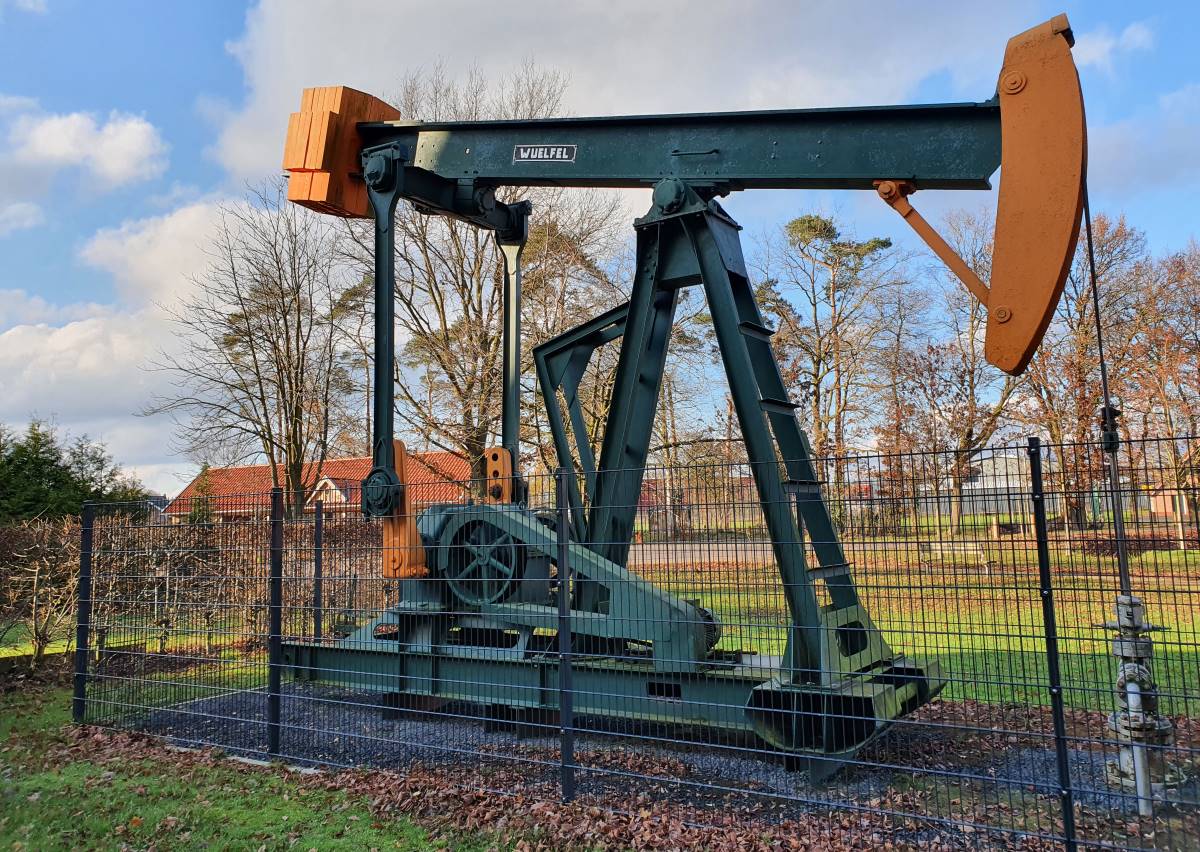
Oil is extracted in the small town of Osterwald in Lower Saxony
Image: Hamsterkiste
People have been using petroleum for thousands of years. In ancient times, they used it to seal boats or lubricate the axles of horse-drawn carts.
The modern oil industry began near the city of Baku. Today’s capital of Azerbaijan once belonged to Russia. In 1844, a major oil field was discovered here, and many more were found in the following decades.
The oil industry began in the USA in 1859. In Titusville, Pennsylvania, engineer Edwin Drake used a steam engine to drill for oil. At a depth of 21 metres, he struck an oil deposit. As demand for oil grew, more oil wells were soon drilled.
Back then, the engineers were helped by the fact that oil is sometimes found just a few metres below the surface and is under high pressure. When such a deposit was drilled into, a jet of sticky oil shot up to 200 metres into the air.
Later, oil was extracted using pumps. Even today, many still look as if they are nodding. The upper part looks a little like a horse’s head, which is why they are also called horsehead pumps. Oil derricks have since been built, making it possible to extract oil from deep underground. Offshore, drilling rigs are used.
Oil is sometimes also found in layers of sand or shale. To extract liquid petroleum from them, they are mined using excavators and trucks. In specialist facilities, the oil is separated from the sand and shale.
To be processed, crude oil must be taken to refineries. It can get there, for example, through a long pipe called a pipeline. Giant oil tankers carry crude oil across the seas.
Find out:
6. Where was a large oil spring discovered in 1844?
7. Why does oil sometimes shoot out of the ground in tall fountains?
8. What is used to extract crude oil today?
9. What are the facilities where it is processed called?
4 Black Gold

Toys are made from plastics. Plastics are made from crude oil.
Image: public domain
Crude oil is sometimes called “black gold”. Today, it is one of our most important sources of energy. We use it to produce fuel for cars, trucks, ships and planes. Oil is used to power electricity-generating plants, and we use oil-fired heating to warm our homes.
At a refinery, crude oil is processed into propane, gasoline, diesel and heavy fuel oil. Bitumen, which is used in road construction, is also made from crude oil.
Many everyday objects would be inconceivable without petroleum. Perhaps you take your lunch to school in a plastic container. It is made of plastic. Packaging, computer and television casings, the paint on our walls, many parts of our cars, toys, clothing, shoes, cosmetics, and chewing gum are also made of plastics. These plastics are made from petroleum.
Find out:
10. Which fuels for engines do we get from crude oil?
11. What everyday items are also made from crude oil, for example?
5 Oil and the environment

A lot of petrol and diesel are consumed in road traffic
Image: Hamsterkiste
Because oil formed from the remains of dead organisms, it is classed as a fossil fuel, like coal, gas and peat.
When fossil fuels are burned, carbon dioxide is released, which we often simply call CO2. Because a great deal of this gas has entered the atmosphere over the last 200 years, our climate is changing. It causes a greenhouse effect. It lets sunlight pass through to the Earth's surface, but prevents the heat created by the sun's rays from escaping into space. As a result, the Earth is getting warmer and warmer.
That is why glaciers and the ice at the North Pole, South Pole, and Greenland are melting. As a result, sea levels are rising and low-lying areas are at risk of flooding. Here, summers are increasingly hot and dry. This harms crops grown by farmers and, above all, our forests.
Sometimes there can also be heavy rain, with a lot of precipitation falling in a short time. Small rivers can then swell into raging torrents. Water can cause widespread damage.
The use of petroleum can cause other damage, too. Oil pipelines can leak, for example, and oil tankers can have accidents. When crude oil spills into the sea, it coats the feathers of seabirds so badly that they can no longer fly. Oil extraction can lead to fires that are difficult to put out and release harmful substances into the environment. The use of diesel in many cars contributes to airborne particulate matter, which can make us ill.
A major problem arises when plastics enter the sea, where they decompose only slowly and pose a serious threat to fish and seabirds.
The world’s oil reserves will last for only a few more decades. Oil consumption also causes many problems, so we should use it more sparingly. Politicians and engineers are working to make greater use of natural energy sources such as water, wind and the sun.
Everyone can help reduce oil consumption. For example, you can travel less by car or plane and take the train or ride a bike more often. You can also look for reusable packaging or buy food that isn’t packaged at all. And please never litter the streets or countryside.
Find out:
12. Which gas is produced when wood, coal, oil and natural gas are burned?
13. How has this changed the climate?
14. What happens when crude oil enters the environment?
15. What other energy sources could be used?