


Chewing and digesting

A sandwich with Maasdam cheese
By Merker Berlin - Own work, Public domain
1 Everything has a beginning and an end


We eat regularly because our bodies need important nutrients found in food. Without food, we can survive for only a few days.
Everyone knows the beginning and end of the story. We get hungry, for example for a cheese sandwich, a croissant or applesauce. We bite into it and chew. And we drink something, perhaps a sip of milk.
After a while, we need to use the toilet. What comes out looks different from what we ate. But what happens to the cheese sandwich, applesauce, or croissant in between?
2 The Journey of Food

Here’s a quick answer to start with: When we eat something, the food first enters the mouth (1).
Then we swallow, and the food passes down the oesophagus (2) into the stomach (3). From there, it is carried through the duodenum (4) into the small intestine (5), and then into the large intestine (6).
Undigested waste is excreted through the rectum (7). By this stage, there isn’t much left of the cheese sandwich, applesauce and croissant. They have been broken down and processed in the body, and the nutrients have been extracted. The rest is excreted. We call this process digestion.
3 Mouth and Oesophagus


It all starts in the mouth. The teeth do most of the work. They bite off a piece of cheese bread or a croissant and chew it. As we chew, saliva is added—children often call it spit. We produce much more saliva when we eat.
Saliva is produced in the salivary glands, which are located in several parts of the mouth. It mixes with chewed food, making it moist and soft. This helps it slide down more easily.
Everything passes from the mouth into the oesophagus. Sometimes small pieces go into the windpipe instead. That also begins in the mouth. When that happens, we cough, which brings the pieces back up.
4 In the stomach
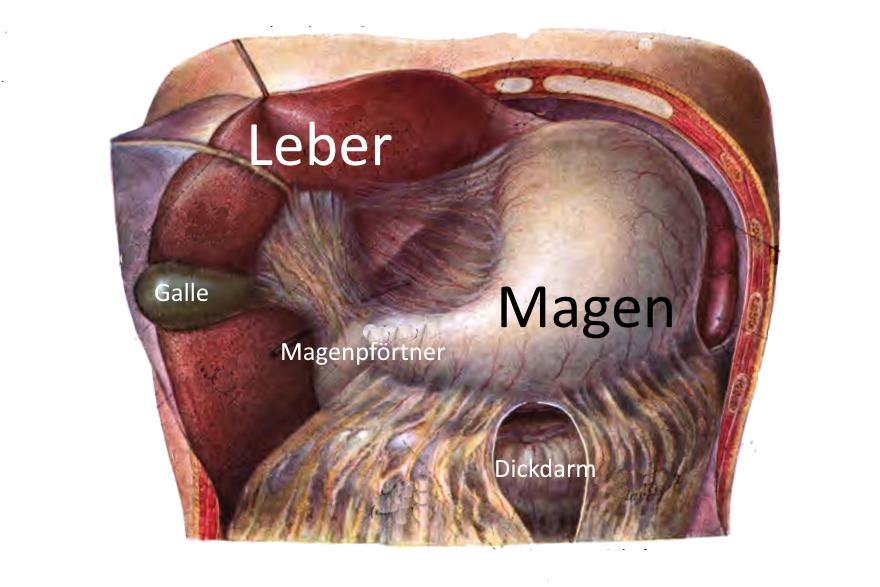
Food passes down the esophagus into the stomach. It lies slightly to the left and below where the lower ribs and breastbone meet. The stomach is lined with the gastric mucosa.
It has small glands that secrete gastric juice. An adult produces 2 to 3 liters of gastric juice each day. Gentle movements help the stomach mix the food thoroughly with the gastric juice. A cheese sandwich stays in the stomach for about three hours; fatty foods are digested there for up to eight hours.
The stomach can hold about 1.5 litres of food at a time. At the entrance and exit of the stomach, there is a ring-shaped muscle. It prevents food from coming back up or leaving the stomach too soon. This muscle is called the pylorus.
5 The liver, gallbladder and an important gland

Once the food we have eaten has been in the stomach long enough, it has turned into a soft, liquid mass. This then passes into the duodenum and from there into the small intestine.
A special digestive fluid is added at the beginning of the small intestine: bile. It is produced in the liver and stored in the gallbladder. The liver is located beneath the right rib cage.
Another important organ is the pancreas. It adds what are known as enzymes. These are needed to separate nutrients from the parts that cannot be digested.
The pancreas also produces hormones that enter the bloodstream. One example is the important hormone insulin. If the pancreas does not produce enough insulin, diabetes develops.
6 In the intestine

In the small intestine, bile breaks down the liquid food into tiny pieces. The inner wall of the small intestine is covered with many small projections called villi. These villi absorb the nutrients our bodies need, especially protein, carbohydrates and fat. These nutrients first enter the bloodstream.
The blood carries them through the veins to where they are needed, for example, to the muscles. Finally, what remains of the food passes into the large intestine. It removes the water from these leftovers. The water is filtered out of the body by the kidneys and collected in the urinary bladder. In an adult, the small intestine is about five metres long, while the large intestine is about 1.5 metres long.
7 In the end, it all comes out

The appendix is located at the beginning of the large intestine. Its small worm-like extension can sometimes become inflamed.
Then we have appendicitis and may need an operation. Food remains stay in the large intestine for at least about 10 hours. If they pass through the body more quickly, we probably have diarrhea. But they can also stay there for several days. If it takes too long, it’s called constipation.
Eventually, everything reaches the rectum and eventually comes back out through the anus. This usually happens here: