


Leipzig
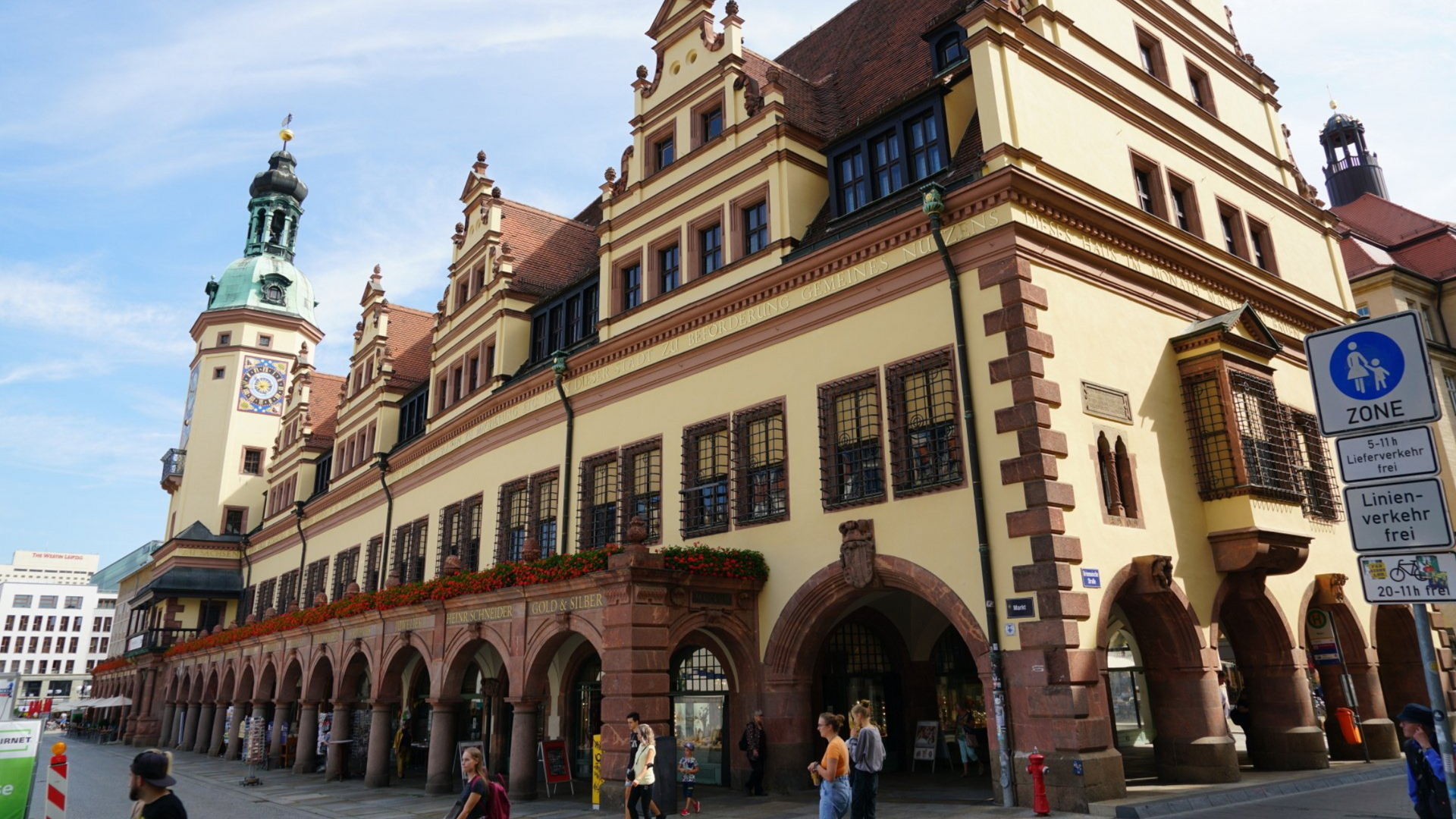
Leipzig’s Old Town Hall
Image: Hamsterkiste
1 Old Town Hall

Banquet hall in the old town hall
Image: Hamsterkiste
Leipzig has existed for at least 1,000 years. Trade has always taken place here. Today, it is still a city of trade fairs and books. The heart of Leipzig is the market square in the old town, where public life has unfolded for centuries.
Food is still sold here today, and concerts are held here too. The Old Town Hall dominates the marketplace. It was built in the 14th century. At that time, the city was governed by a council. They had rooms built in the building for their meetings, offices for the town clerks, a treasury and a large banquet hall.
The town hall was also meant to reflect the city’s prosperity and importance. The building has been remodelled many times. Unlike most town halls, its tower does not stand in the centre of the building, but is offset to one side.
Below the tower is a passageway from the market square to the Naschmarkt, an old fruit and vegetable market. In 1905, the city administration of Leipzig moved into a new town hall. The Museum of City History has been housed in the Old Town Hall ever since.
2 Old Stock Exchange

Many business deals were once concluded at the Old Stock Exchange in Leipzig
Image: Hamsterkiste
As far back as centuries ago, major trade fairs were held in Leipzig several times a year. Merchants displayed their goods, buying and selling. These fairs used to be held in the market square in front of the Old Town Hall. Trade made many merchants rich.
In 1678, they had a magnificent building constructed on the Naschmarkt behind the town hall. They could do business here throughout the year or hold celebrations. The merchants’ wealth is reflected in the building’s splendid, richly decorated design. Above the door is the town coat of arms, held by two boys.
As Leipzig grew in the 19th century and its trade fairs attracted more and more merchants, a new, larger stock exchange was built. The building at Naschmarkt became the Old Stock Exchange.
3 The New Town Hall

The New Town Hall has a 114-meter-high tower
Image: Hamsterkiste
The 114-metre tower of the New Town Hall can be seen from a long way off. The new building was needed because the Old Town Hall on the market square had become too small. It was built between 1899 and 1905.
There used to be a medieval castle here, the Pleißenburg. Later, the Stadthaus was built and connected to the town hall by a bridge. Together, the two buildings have more than 600 rooms and cover an area of 10,000 square metres.
The New Town Hall was lavishly decorated inside and out. Images and coats of arms, gargoyles and statues depict themes from the city’s history. Two galleries are connected by a grand staircase made of granite and marble.
4 St Thomas Church

The famous composer J. S. Bach worked in this church
Image: Hamsterkiste
This church stands out for its octagonal tower and steep roof. St. Thomas Church in Leipzig is one of the city’s best-known churches. It owes this above all to the great composer Johann Sebastian Bach, who worked here from 1723 until his death in 1750.
His tomb is in the church’s choir, his portrait adorns a church window, and a monument to him stands in the churchyard. Bach was employed as cantor at St. Thomas Church. In this role, he was responsible for the church’s musical performances, music lessons at the St. Thomas School, and directing the Thomanerchor.
5 St. Nicholas’ Church

St. Nicholas Church is the oldest church in Leipzig
Image: Hamsterkiste
St. Nicholas Church is named after Saint Nicholas and is the oldest church in Leipzig. It was built in 1165 and has been remodelled several times since. Among other things, the church interior was renovated. The columns, for example, were designed based on ancient Greek and Roman models.
White, pink and pale green dominate the interior. In 1989, a small number of members of the congregation gathered every Monday to pray for peace. Soon, more and more people joined these prayers and then demonstrated for greater civil rights and democracy in the GDR. This grew into a major peaceful revolution. Just two months after the first demonstration, the Berlin Wall fell on 9 November, and a year later the two German states were reunited.
Several works of art in the square in front of the church commemorate these events, including the Nikolai Column.
6 The Gewandhaus

The Gewandhaus is a large concert hall
Image: Hamsterkiste
The Gewandhaus in Leipzig is a large concert hall with room for 1,900 people. The Gewandhaus Orchestra has 185 musicians. It is one of the largest orchestras in the world. The name of the concert hall comes from Leipzig’s first concert venue. It was located in the city’s armory, the Zeughaus. Later, wool and cloth merchants used the building, and it came to be called the Gewandhaus.
An orchestra founded by wealthy merchants played there from 1781. In 1884, a new concert hall was built, but the name Gewandhaus was retained. The building was completely destroyed during the Second World War. The present-day Gewandhaus on Augustusplatz was eventually built during the GDR era. The largest and most magnificent fountain in Leipzig, the Mendebrunnen, stands in front of the building. In the entrance halls to the concert hall, you can see Europe’s largest ceiling painting.
7 The Opera

The Leipzig Opera House
Image: Hamsterkiste
The Leipzig Opera House is also located on Augustusplatz. You can enjoy opera and ballet performances here. The music for the performances is played by the Gewandhaus Orchestra. The present building was opened in 1960, when East Germany still existed.
It is made of light-coloured sandstone and arranged in seven stepped tiers. The opera house seats 1,264 visitors.
8 The University

The university has been around for more than 600 years
Image: Hamsterkiste
The University of Leipzig is one of the oldest in Germany. It was founded in 1409. At the time, about 1,000 students and their teachers left the University of Prague and founded a new university in Leipzig. Its Latin name has been Alma Mater Lipsiensis ever since. The university became very popular and was, for a time, the largest in Germany.
During the GDR era, the university was renamed Karl Marx University. After German reunification in 1990, the university’s historic centre at Augustusplatz was restored. Around 31,000 students are currently enrolled at the University of Leipzig.
9 The City-Hochhaus

The City-Hochhaus is 142 m tall
Image: Hamsterkiste
The City-Hochhaus is the tallest building in Leipzig. It is 142 metres tall and has 29 floors. It was built between 1968 and 1972. Its three slightly concave sides make it look like an open book.
It was intended to draw attention to the Leipzig Book Fair and the university, which was building a new main building here. Today it belongs to an American bank. At a height of 110 metres, there is a restaurant and an observation deck.
10 The arcades

The arcades make it possible to shop even in bad weather
Image: Hamsterkiste
Leipzig city centre has several covered passageways between buildings, lined with shops, cafés and restaurants. They let you shop and stroll even in bad weather, without getting wet. These passageways are known as arcades. They are elaborately designed, and there are 24 in total.
11 The Central Station

Leipzig Central Station has several shopping arcades and 21 tracks
Image: Hamsterkiste
Leipzig Central Station is a terminus. Most trains leave it again in the direction they came from. It is the largest terminus in Germany. Its façade alone is 298 metres long, and it has 21 railway tracks.
A few years ago, it underwent extensive renovations, including the construction of a large parking garage and several shopping arcades in the station building. Today there are around 70 shops here, making it a large shopping center as well.
12 Leipzig, City of Trade Fairs


Every year in March, a book fair is held in Leipzig. New books are showcased, authors read from their work, and books are discussed at many events.
Book fairs have been held in Leipzig since the 17th century. Today, only the Frankfurt Book Fair attracts more visitors and exhibitors.
Today, there is a large exhibition center in the north of the city, with an 80-meter-wide, 243-meter-long glass hall and an 85-meter-high exhibition tower. The letters MM, which stand for “Muster Messen,” can be seen from far away.
13 People speak Saxon in Leipzig


Mural in the old town
The poster below says, “Mein Leibzsch lobsch mir...” This means, “I praise my Leipzig.” In Leipzig, as in other parts of Saxony, people speak Saxon. It is one of the many dialects we use to communicate in Germany.
Well, take care! See you soon!