


Egyptian geese mainly live in Africa south of the Sahara. But in recent years they have also spread across Western Europe. For a long time, they were kept only in parks there. Then some birds escaped, and their descendants now live in the wild. They prefer to stay near water.
Egyptian geese differ from other geese by their relatively long legs and dark eye patches. Their plumage is an irregular mix of colors. Males and females look alike, although males are slightly larger. Their bills are pale red to deep red.
Egyptian geese build their nests in reed beds and sometimes among rocks or in tree hollows. In Africa, they sometimes build their nests 20 meters above the ground.
The eggs are white and slightly glossy. The incubation period is 30 days. Both parents help care for the goslings. At about nine to ten weeks old, they are fully grown and can fly. - Image: Hamsterkiste
42 Carrion Crow
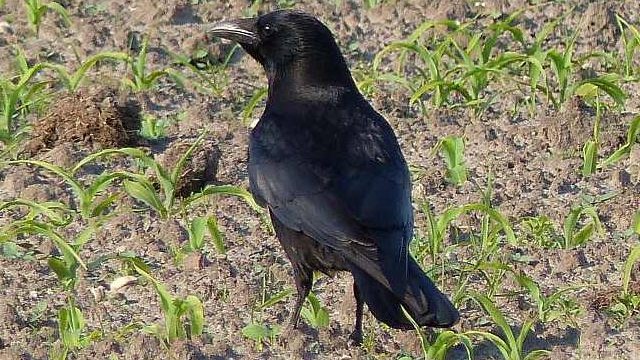
The carrion crow and the hooded crow are subspecies of the carrion crow. The hooded crow is found east of the Elbe and in Scandinavia. The carrion crow is found in Western Europe, roughly as far as the Elbe. The carrion crow has deep black plumage. It grows to about 47 cm long and has a wingspan of around 95 cm. Carrion crows live in fields and open woodlands. In winter, they often stay near rubbish dumps. That’s because crows are omnivores. They eat insects, worms, snails, mice, frogs, the eggs of other bird species and young hares. But they also eat human rubbish and dead animals of every size. Crows stay with the same partner for many years. They can live for up to 70 years. They breed from March to June. The carrion crow nests in trees. The female lays 4 to 6 greenish eggs in the nest. The chicks hatch after about 3 weeks. After a further 30 to 35 days, they leave the nest. - Image: Hamsterkiste
43 Barn Swallow

The barn swallow is slightly larger than the house martin, reaching a length of 18 cm. Its upperparts are similar in colour to those of the house martin, and its underparts are also white. Only its forehead, chin and throat are reddish brown. Its tail is long and deeply forked. Swallows are often found near farms, in villages and in towns. They hunt a variety of small insects, but mainly flies and mosquitoes, which they catch in flight. They are exceptionally agile and nimble in the air. Swallows usually build their nests in buildings and barns. The barn swallow’s nest is more open than the house martin’s. The 4 to 6 eggs are incubated for 12 to 14 days, and the young are cared for by their parents for about 3 weeks. Swallows are migratory birds. They fly to areas south of the Sahara in Africa, and some even travel as far as South Africa. - Image: Hamsterkiste
44 Partridges

Partridges have become very rare here and are at risk of extinction. They grow to about 30 cm long and weigh 400 g. Their grey-brown plumage makes them very well adapted to their habitat. But this habitat is shrinking all the time. They need a landscape with small fields, lots of hedgerows and wide field margins. Here they can find shelter from predators and plenty of food in old, tall grass. They feed on insects, spiders and wild herbs. They also need sandy hollows where they can “bathe” their plumage.Partridges build their nests on the ground. In May, females lay 18 to 22 eggs, which hatch after 23 to 25 days. The chicks can leave the nest straight away and fly after about 2 weeks. The hen and cock stay together for life. Both parents take equal care of raising the young. Partridges are resident birds. - Image: US Fish and Wildlife Service / public domain
45 wood pigeons

Wood pigeons are the largest native pigeons. They grow to over 40 cm long and weigh about 500 g. Their backs and wings are grey-brown. The white band below the back of the head is particularly striking. Wood pigeons used to live only in forests. These days, however, they are also quite common in our towns and cities, in parks and gardens. They feed on seeds, buds, acorns and grain. As their natural predators have become less common, wood pigeon numbers have increased over the past few decades. Wood pigeons build shallow, loose nests in trees. The female lays just two eggs. Both parents take turns incubating them. The chicks hatch after about 17 days and are cared for by their parents for around five weeks. Wood pigeons stay here all year round, so they are resident birds. - Image: Hamsterkiste
46 Redwing

The redwing is easily mistaken for the song thrush. However, it is slightly smaller and has rusty-red coloring on its flanks beneath the wings. It has a pale stripe above its eyes. It grows to about 21 cm long and weighs 55 to 75 g. Redwings mainly live in spruce and birch forests in northern Europe. They feed on worms, insects and berries. The redwing builds its nest hidden in bushes. The female lays 5 to 6 eggs, which hatch after about 12 to 14 days. The young leave the nest after a further two weeks. Redwings can be seen here only in autumn and spring. They spend the winter in warmer regions around the Mediterranean and the summer farther north from us. - Image: axelkr (CC BY-SA 2.5)
47 Robin

This small bird has an orange-red breast and throat. Its back is brownish, and its eyes are strikingly black. The robin grows to about 14 cm long and weighs 10 to 20 grams. It lives in woods with plenty of bushes, as well as in gardens and parks. It often searches for food on the ground, where it finds small beetles, caterpillars, spiders, worms and snails. In autumn, it enjoys eating berries and small fruits. It builds its nest close to the ground, in undergrowth or among tree roots. The female lays 3 to 9 eggs in it two or three times a year. The young hatch after 12 to 15 days and leave the nest another two weeks later. Some robins spend the winter here, while others migrate to North Africa or Spain for the colder months. In gardens, they often come very close to people. - Image: Hamsterkiste
48 Barn Owls

The barn owl is particularly recognizable by its heart-shaped facial disc. Other owls have rounded wings, whereas the barn owl’s wings are long and pointed. When perched, its wings extend beyond its tail. It is about 35 cm long and weighs 300 to 350 g. Barn owls live in rocky areas, but also like to nest in barns, church towers and older buildings. They mainly hunt at night and feed mostly on mice. Each night, they catch 4 to 5 mice, sometimes also moles, rats or large insects. In April or May, the female barn owl lays 4 to 7 dull white eggs on the bare floor of the nest site. Laying the eggs takes 2 to 3 days. But the owl starts incubating after laying the first egg. The chicks hatch after 32 to 34 days. Because of this incubation pattern, the chicks are different ages. The youngest may even starve if their parents cannot find enough food. Young barn owls depend on their parents for a very long time. They can fly only after 60 days, and are not independent until they are about 4 months old. Barn owls are resident birds, so they stay here all year round. - Image: Hamsterkiste
49 Herring Gull

Herring gulls are true masters of flight. They fly slowly and steadily, using the updrafts over the sea to soar. Their heads and undersides are whitish, while their backs and wings are grey. They grow to about 60 cm long and have a wingspan of 150 cm. Herring gulls are widespread in Europe and America. They mainly live along the coasts of seas and oceans. They are omnivores. They search for food in rubbish, steal prey from other birds, and take their eggs and chicks. They nest in colonies with other gulls, usually on low-lying islands off the coast. The breeding season begins in April and lasts until July. Females usually lay 3 eggs in a nest on the ground. Herring gulls breed two to three times. The chicks hatch after 28 to 29 days and leave the nest after just 2 days. However, their parents continue to feed them for another 6 weeks. - Image: Hamsterkiste
50 Song thrush

The song thrush is closely related to the blackbird. It grows to about 23 cm long. Its upper plumage is brownish, while its underside is pale. It has black spots on its breast. Males and females have the same coloring. Song thrushes live in forests with lots of undergrowth. They are also found in parks and gardens. They eat all kinds of insects that they find on the ground. They also eat worms, snails and caterpillars. Song thrushes build their nests in trees or shrubs. The nest is made of plant material. The inside is smoothed with a layer of clay. The female lays 4 to 6 eggs in it. They are incubated for 13–14 days. The young are ready to fly just two weeks after hatching. Most song thrushes are migratory birds and spend the winter in southwestern Europe or North Africa. Some, however, stay here. - Image: Hamsterkiste