


On February 15, 2013, a meteorite burned up over the Russian city of Chelyabinsk - Image: Nikita Plekhanov (CC BY-SA 3.0)
Dangers from Space
On the morning of February 15, 2013, a meteoroid exploded over the Russian city of Chelyabinsk. The city lies about 1,500 km east of the capital, Moscow. The meteoroid is estimated to have weighed about as much as a loaded truck. Much of its mass burned up as it entered Earth’s atmosphere. The rest broke into many small pieces that reached the ground. One of them tore a six-meter-wide hole in the ice covering a frozen lake.
But the meteoroid caused a powerful shock wave at ground level. Thousands of windowpanes shattered, roofs and walls were damaged, and the roofs of large buildings collapsed. Flying fragments injured more than 1,000 people.
Even more happened on 15 February 2013. That evening, an asteroid that scientists had named “2012 DA14” passed Earth at a distance of only about 27,000 km.
It was considerably larger than the meteoroid that broke apart over Russia that morning. It would certainly have caused much greater destruction if it had collided with Earth.

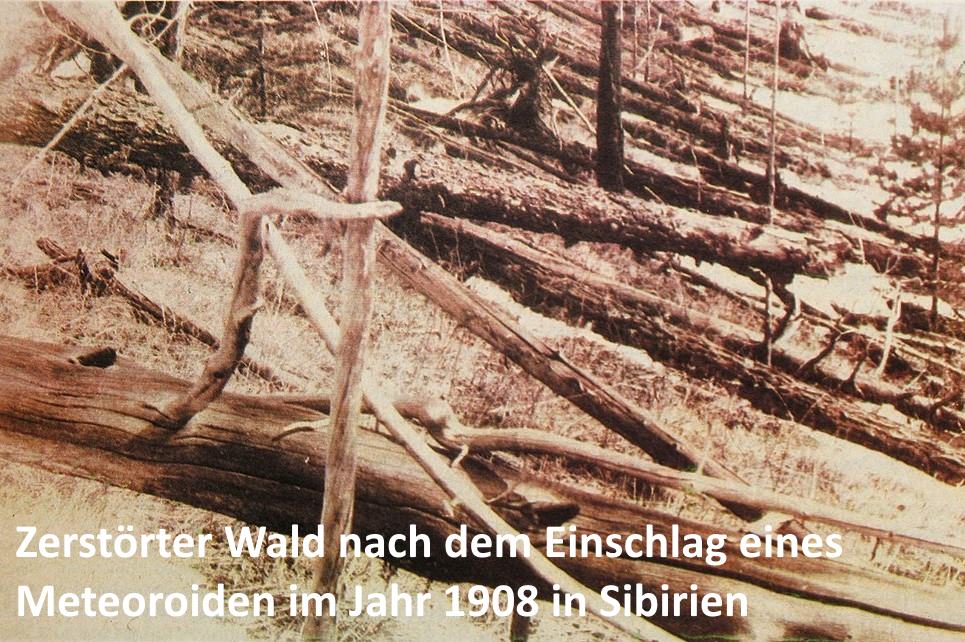
The Earth is hit by small meteoroids every day. Most burn up in the Earth's atmosphere and never reach the ground. It is estimated that around 25 lumps actually land on Earth each day. They are so small that they usually cause no damage. But you can see what the meteoroid did in Arizona. A similar chunk could completely devastate a large city today. However, an impact like this only happens once every few centuries. Scientists are working on ideas for how to divert a celestial object that is on course to hit Earth. The last meteoroid impact to cause major damage took place in Russia in 1908. A fairly large chunk exploded over the Tunguska River. All the trees were knocked down and scattered. The affected area was as large as the Saarland.
It happened about 14.6 million years ago in what is now southern Germany. A large asteroid struck at a speed of more than 50,000 km/h. It is estimated to have been about 1,500 m in diameter.
Huge boulders were hurled up to 70 km away. Within a radius of about 100 km, almost all life was wiped out in a matter of minutes. A crater 25 km in diameter and 500 m deep formed, surrounded by a high rim. It later filled with water and became a large lake.
About 40 km farther south, we can still see another crater that formed around the same time. It is 3.5 km in diameter.
The area is now densely populated, and the lake disappeared long ago. But the depressions caused by the asteroid impacts are still visible. The larger crater is where the town of Nördlingen was built; the smaller one is home to the municipality of Steinheim. Today, we call the larger crater the “Nördlinger Ries” and the smaller one the “Steinheim Basin.”


Image: D. Roddy, U.S. Geological Survey (public domain)