


In the Senne

The Senne is a unique landscape
Image: Hamsterkiste
1 A special landscape

Heather in bloom in the Senne

The heather blooms in August
The Senne lies in the east of the state of North Rhine-Westphalia. This distinctive landscape is about 45 km long and up to 15 km wide. It was formed when the enormous weight of Ice Age glaciers pushed them over the nearby Teutoburg Forest. They scraped away a great deal of fine sand, which the streams and rivers deposited at the foot of the hills.
The sandy soils of the Senne contain very few nutrients. That is why there are not as many trees and forests here as in other areas. Today, this is the largest heathland in North Rhine-Westphalia. The Senne has been inhabited for only about 800 years.
People let their livestock graze and felled the few trees. This caused the landscape to become increasingly barren, creating large areas of heathland.
The heath farmers removed heathland soil to use as bedding in their livestock sheds. This created sandy areas where only a few plants could grow. Dunes formed in some places. In the past, when everyone had to make a living from farming, most people living in the Senne were very poor. Hunger, disease and cold were common. Many lived in simple houses made of clay and wood, with the wind whistling through the cracks.
2 The Ems rises in the Senne

The Ems is a 371-kilometre-long river that flows through the states of North Rhine-Westphalia and Lower Saxony and empties into the North Sea near Emden.
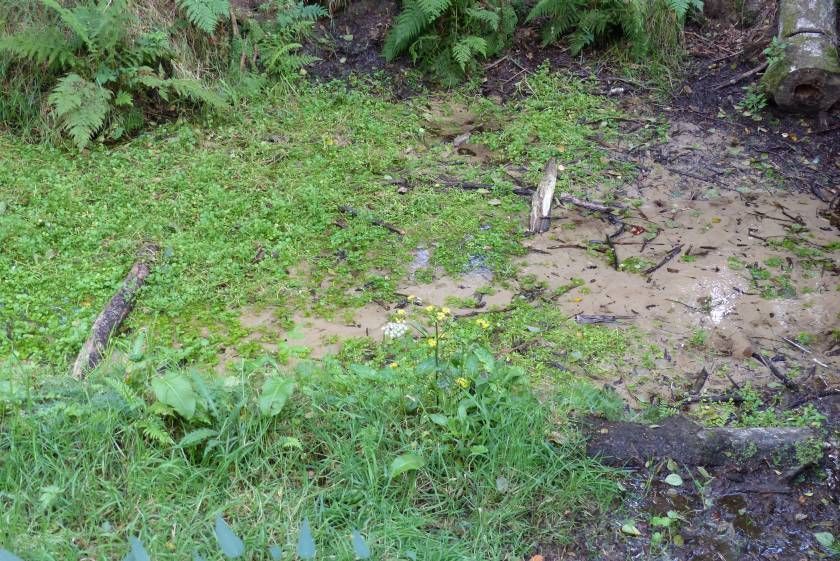
The Ems rises in the Senne, in a nature reserve known as Moosheide. This area lies in the town of Schloss Holte-Stukenbrock, which developed from several small communities. Like other springs, the Ems source is formed when rainwater seeps into the ground. Sometimes it encounters a layer deep underground that water cannot pass through. This creates an underground lake.
At lower elevations, the water eventually emerges at the surface again. This is where a spring forms. Water from several small springs gathers to form a stream, which eventually becomes a river as other streams flow into it. The water that wells up from the ground in the Moosheide has a temperature of around 6 to 9°C.
3 The Military Training Area

There are no human settlements on the military training ground

Soldiers training with tanks on the military training ground
To this day, a large part of the Senne is still a military training area. Soldiers learn here to shoot rifles, move through the terrain, and operate tanks and other vehicles.
It all began in nearby Paderborn. In the 19th century, cavalry troops were stationed there—in other words, soldiers on horseback. They used the Senne for rides and drills. Later, a large military training area was established and continually expanded. Today, almost half of the Senne is a restricted military zone. The soldiers of Emperor Wilhelm II and later those of the dictator Adolf Hitler were trained here.
After the end of World War II, the site was occupied by the British Army. Today, soldiers from Germany, Great Britain and other countries train here. In this uninhabited area, they fire live ammunition and tanks carry out manoeuvres.
4 The Great Cemetery


The obelisk erected by the liberated prisoners
After Germany, under Adolf Hitler, had started the Second World War, a prisoner-of-war camp was established at the Senne military training area in 1941.
Over the following four years, 300,000 soldiers, mainly from the former Soviet Union, were held here. They had to do hard physical labor and were given very little to eat. Many died of hunger or disease, or after being mistreated by guards. The exact number of prisoners who died in this camp is unknown, but estimates put it as high as 65,000.
Most of them were buried in mass graves. In early April 1945, American troops liberated the camp. The survivors immediately began restoring the cemetery to a dignified condition. They erected an obelisk with the flag of the Soviet Union depicted in glass on it. This flag was later replaced with a cross.
Since then, numerous memorial stones, sculptures and plaques have been erected in the cemetery, now known as the Cemetery of Honor. They are intended to commemorate the suffering of prisoners of war and the terrible consequences of war and dictatorship.
5 Nature in the Senne


There are no settlements or factories, and hardly any roads, on the large military training area in the Senne. This is a great advantage for nature, which can develop undisturbed here. The Senne is home to about 5,000 animal and plant species, including around 900 that are on the “Red List” because they are now rare in our region.
The streams of the Senne also contribute to this diversity. Their water is clean and unpolluted. Badgers, foxes, martens and hares find good conditions here. Roe deer and red deer can graze undisturbed during the day and don’t have to wait until dusk.
6 The Senner Horses

Senner horses are one of Germany's oldest horse breeds

Today, some animals live in a 15-hectare nature reserve
Wild horses lived in the Senne as early as the Middle Ages. They were the “Senner horses”, one of Germany’s oldest horse breeds. These animals are very hardy and can be used as riding horses or for show jumping.
In the past, the princes of Lippe ran a well-organized horse-breeding program here. They built a stud farm beside their hunting lodge, Lopshorn, on the edge of the Teutoburg Forest. Originally, the horses were allowed to graze freely in the Senne all year round. Later, they were kept in stables during the winter.
Today, Senner horses have become rarer. Efforts are being made to preserve the breed and let the horses live in the wild as they did in the past. Since 2000, several animals have once again been grazing in the wild like their ancestors, in a 15-hectare nature reserve.
Images: Hamsterkiste (8), Achim Röder (3), Municipality of Hövelhof (2), public domain (3)