


Flag of the Republic of Poland
Image: public domain
Republic of Poland
1 Land and People

Street scene in Krakow
Image: Hamsterkiste
As of March 31, 2021, Poland had a population of 38,179,800 spread across an area of 312,696 square kilometers. That means there are 123 people per square kilometer. Many people emigrated from Poland over the past centuries. They left for political reasons, because they were very poor, or because they had no work. Today, several million Poles live around the world in countries outside Poland. The largest group has made a new home in the United States of America (USA). About 2 million people in Germany come from Poland, or have a parent who comes from Poland. Polish is spoken in Poland, but there are also several minority languages. These include Kashubian in the Gdańsk region, German in and around Opole, Belarusian near the border with Belarus, and Ukrainian. Almost 90 percent of the population belongs to the Catholic Church. The country is also home to Orthodox Christians, Protestants, Muslims and Jews.
2 Poland is divided into 16 regions called voivodeships. Each voivodeship has its own parliament and a chief official called a voivode. Poland’s capital is Warsaw. In Polish, the city is called Warszawa. As of December 31, 2023, it had a total population of 1,861,975.
The Culture Palace stands in the city centre. It is 234 metres tall. Its 38 floors contain 3,288 rooms and 33 lifts. It houses theatres, museums, a swimming pool, offices and large halls.
2 The capital and the voivodeships

City Hall in Wroclaw (Breslau)
Image: Hamsterkiste
Poland is divided into 16 regions called voivodeships. Each voivodeship has its own parliament and a chief official called a voivode. The capital of Poland is Warsaw. In Polish, the city is called Warszawa. As of December 31, 2023, it had a total population of 1,861,975. In the city center stands the Palace of Culture and Science. It is 234 meters tall. Its 38 floors house 3,288 rooms and 33 elevators. It contains theaters, museums, a swimming pool, offices and large halls.
3 Other major cities

Krakow’s market square, with the Cloth Hall and Town Hall tower
Image: Hamsterkiste
The second-largest city in Poland is Kraków. In German, the city is called Krakau. It has nearly 780,000 residents. The third-largest city is Łódź, with about 672,000 residents. Wrocław (Breslau) has 642,000 residents, Poznan (Posen) 532,000, and Gdansk (Danzig) 471,000. Other large cities include Szczecin (Stettin), Bydgoszcz, and Lublin.
There are 954 cities in Poland. Forty-two have more than 100,000 inhabitants and are therefore considered large cities. But just 329 people live in Opatowiec, Poland's smallest city.
4 Rivers and lakes

The Oder near Frankfurt. Here, it forms the border between Germany and Poland.
Image: Hamsterkiste
The country’s longest river is the Vistula, which is 1,022 kilometres long. In its upper reaches, the Oder forms the border between Germany and Poland. In the east, along the borders with Belarus and Ukraine, the Bug flows.
The largest lake in the country is Śniardwy (Lake Spirding) in northeastern Poland. It is part of the Masurian Lake District, a region with many forests, lakes, canals and rivers.
5 Coastlines, Mountains and Landscapes
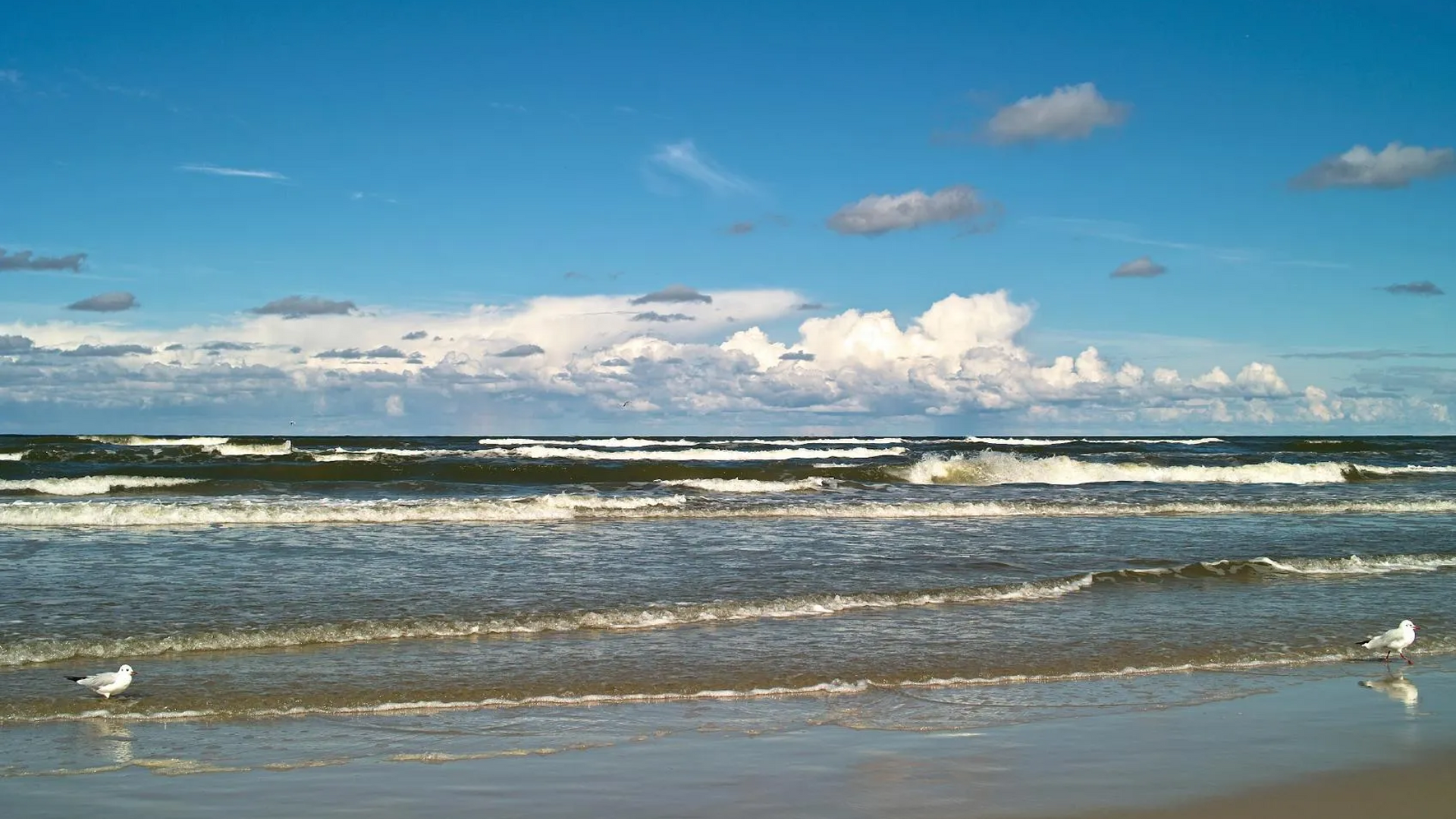
The Baltic Sea near Kołobrzeg (Kolberg)
Image: Hamsterkiste
Poland has a 524-kilometer coastline along the Baltic Sea in the north. To the south, the peaks of the Tatra Mountains rise high above the landscape. Poland’s highest mountain, Rysy, is also there, standing 2,500 meters tall. Part of the Tatra Mountains lies in Poland and the rest in Slovakia. Other mountain ranges in Poland include the Sudetes, the Carpathian Foothills, and the Świętokrzyskie Mountains.
6 Forests

In the Białowieża Forest
Image: By Ralf Lotys, CC BY 3.0
About a third of Poland is covered in forest. The Białowieża Forest, on the border with Belarus, is a very special area. This nature reserve is home to one of Europe’s last primeval forests. Here, people leave everything to nature and do not interfere. The Białowieża Forest is home to Europe’s tallest trees, which grow up to 50 metres high. Poland is also home to brown bears, wolves, lynx, European bison and moose, as well as more storks than any other country in Europe.
8 The Economy

The city of Poznan (Posen) is the economic center of western Poland
Image: Hamsterkiste
Poland’s economy is growing. Even so, people earn less on average than, for example, in Germany. Agriculture was very important in Poland for a long time. Poland is still one of the European countries that grows the most onions, cabbage, strawberries, and apples.
But most people have long since earned their living in other occupations, in banking, tourism, industry, and the manufacture of machinery and electronic devices. Poland also has many mineral resources, such as coal, copper and sulfur.
9 President, Government and Parliament

The Sejm building in Warsaw is home to the Polish parliament
Image: Kpalion (CC BY-SA 3.0)D
After World War II, Poland became a country in the Warsaw Pact, which was dominated by the Soviet Union. The Communist Party of Poland was the country’s leading force. But more and more people were dissatisfied with the situation. Under the leadership of the “Solidarnosz” trade union, Poland eventually became a democracy, with a freely elected parliament and political parties competing for power.
Today, Poland is headed by a president. The president is elected for a five-year term. All Poles aged 18 and over are allowed to vote. After serving one five-year term, a president may be re-elected once, but not again after that.
Every four years, Poland elects a parliament that decides on the country’s laws. The parliament has two chambers, where politicians and parties discuss issues and make decisions. One is the Sejm, which has 460 members. The other chamber is called the Senate and has 100 members. When politicians from both chambers meet, this is called the National Assembly. The government is headed by a prime minister.